

Manufacturers
Meyer-Chemie
Special chemical-technical products
- Items
- 6
- Categories
- 8
- Founded
- 1956
- Headquarters
- Enger, Germany
What are you looking for?
About Meyer-Chemie
Meyer-Chemie is a family business from Enger in East Westphalia that has been making chemical-technical products for painters, tradespeople and the paint industry since 1956. The range covers the tasks for which there is otherwise no solution in the toolbox: woodworm control, linseed oil varnish, wallpaper remover, cement haze and sticker removers. We stock these specialities in household-sized containers – usually exactly the quantity needed for one job.
With woodworm the holes are the end, not the beginning
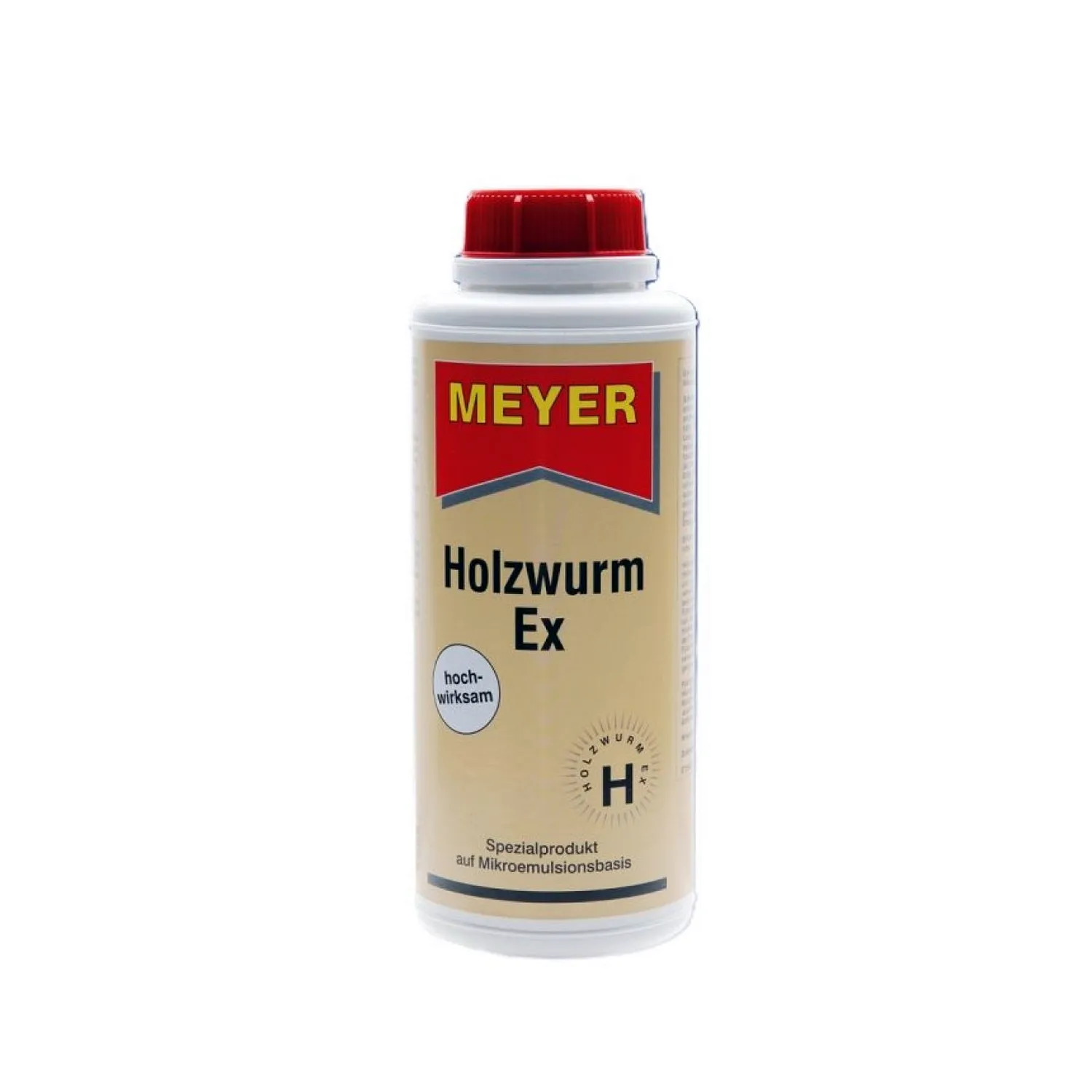
The small round holes in the beam are exit holes. They are created when the finished beetle leaves the wood – by then the damage was done long ago. It was the larva that did the feeding, over years inside the wood where it cannot be seen. Anyone who only treats the holes therefore treats the place where there is no longer any animal.
In practice this means: apply generously, several times, and flood the exit holes in a targeted way with the syringe so that the agent runs down the gallery. And ventilate and cover beforehand – wood preservatives are biocidal products, and the labelling and the instructions for use on the container are binding.
Selection guide: which Meyer product for which problem?
The overview arranges the Meyer range we stock by task. The details in the last column come from the product data of the respective article.
| Product | Base | Purpose | Special feature |
|---|---|---|---|
| Meyer Holzwurm EX | Wood preservative | House longhorn beetle larvae in wood | Liquid, with brush or syringe · 200 g/m² · 750 ml |
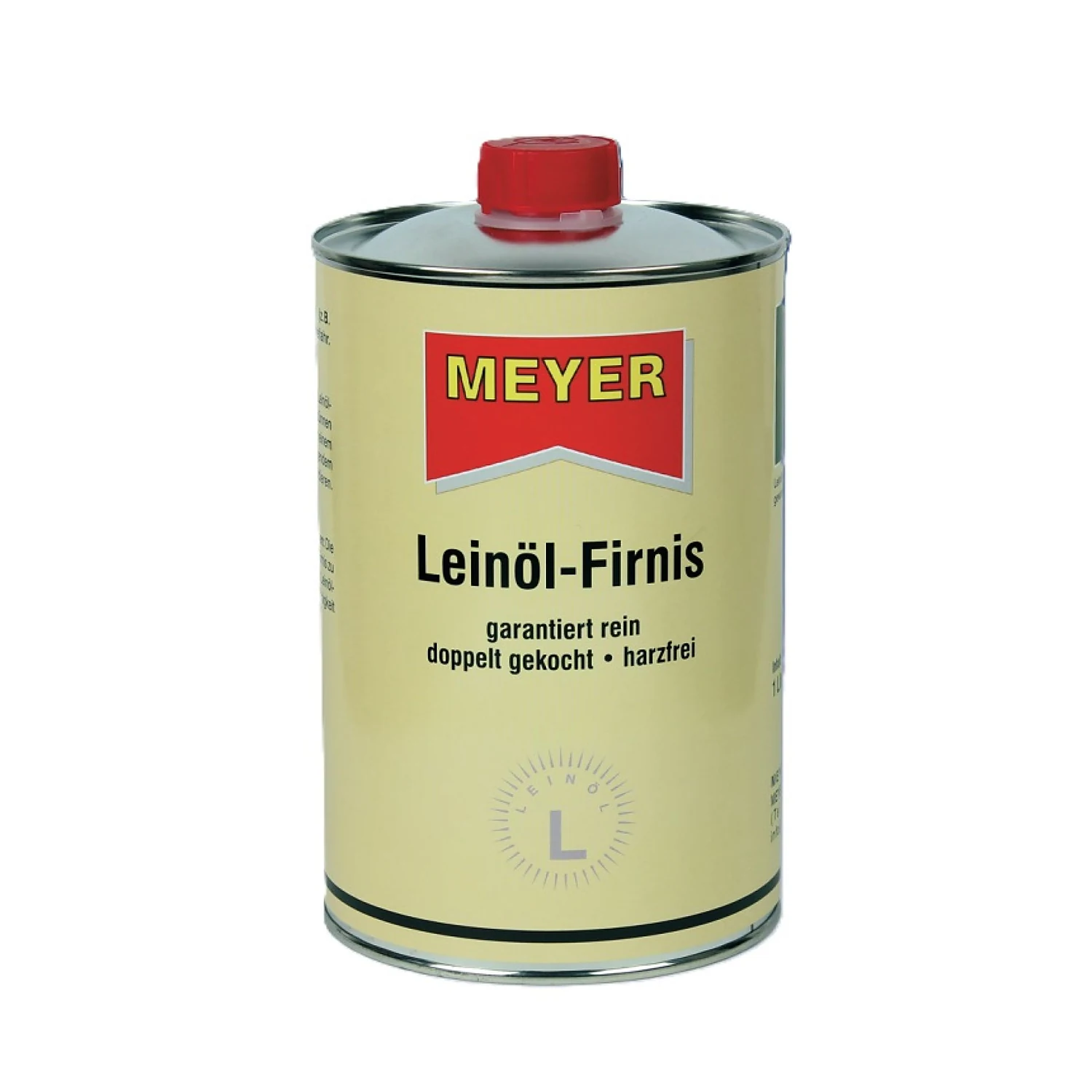
| Meyer linseed oil varnish | Linseed oil | Sealing wood, supplementing primers | Double-boiled and resin-free · with driers · 1 l |
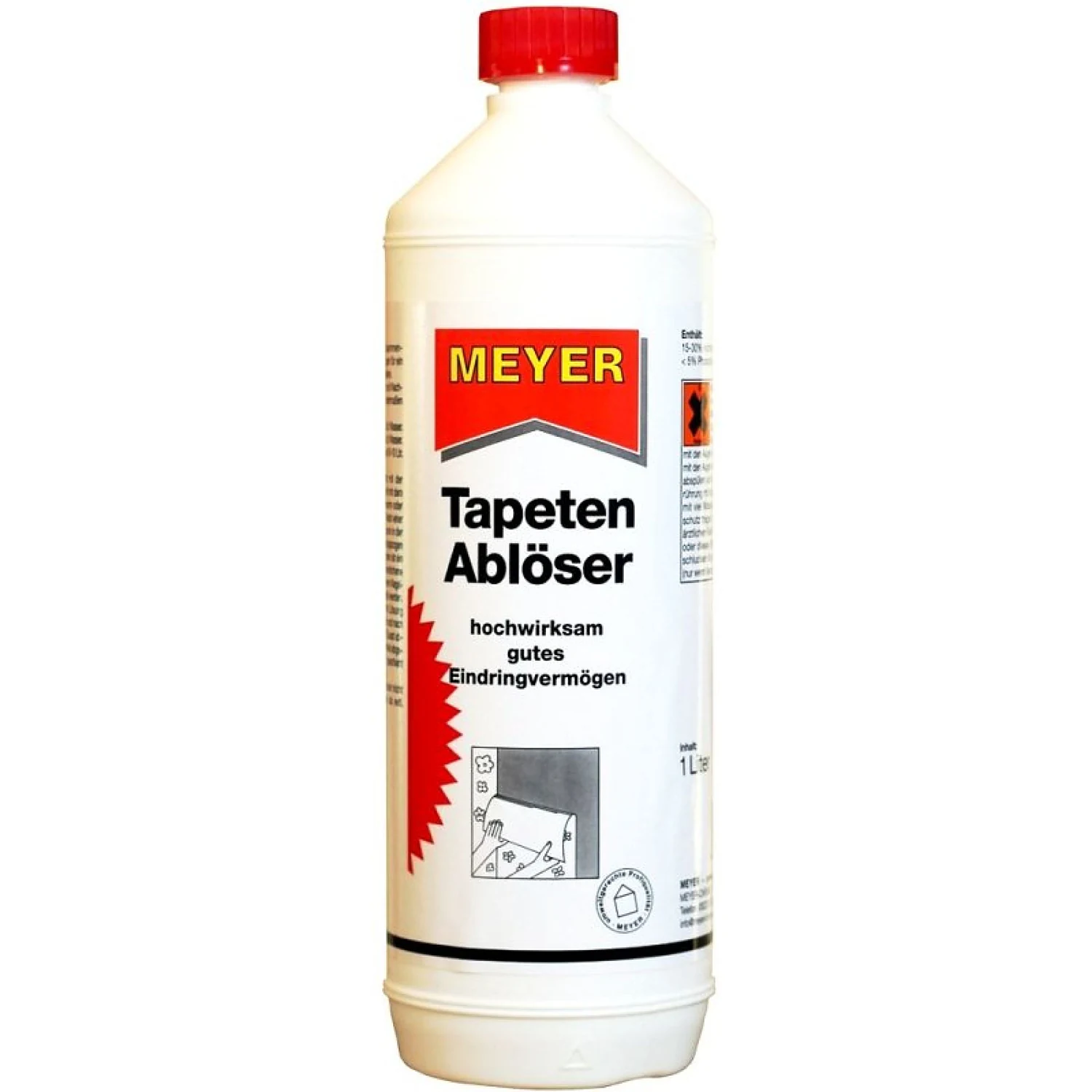
| Meyer wallpaper remover | water-based | loosening old and painted-over wallpaper | Works after a few minutes · transparent, no discolouration |
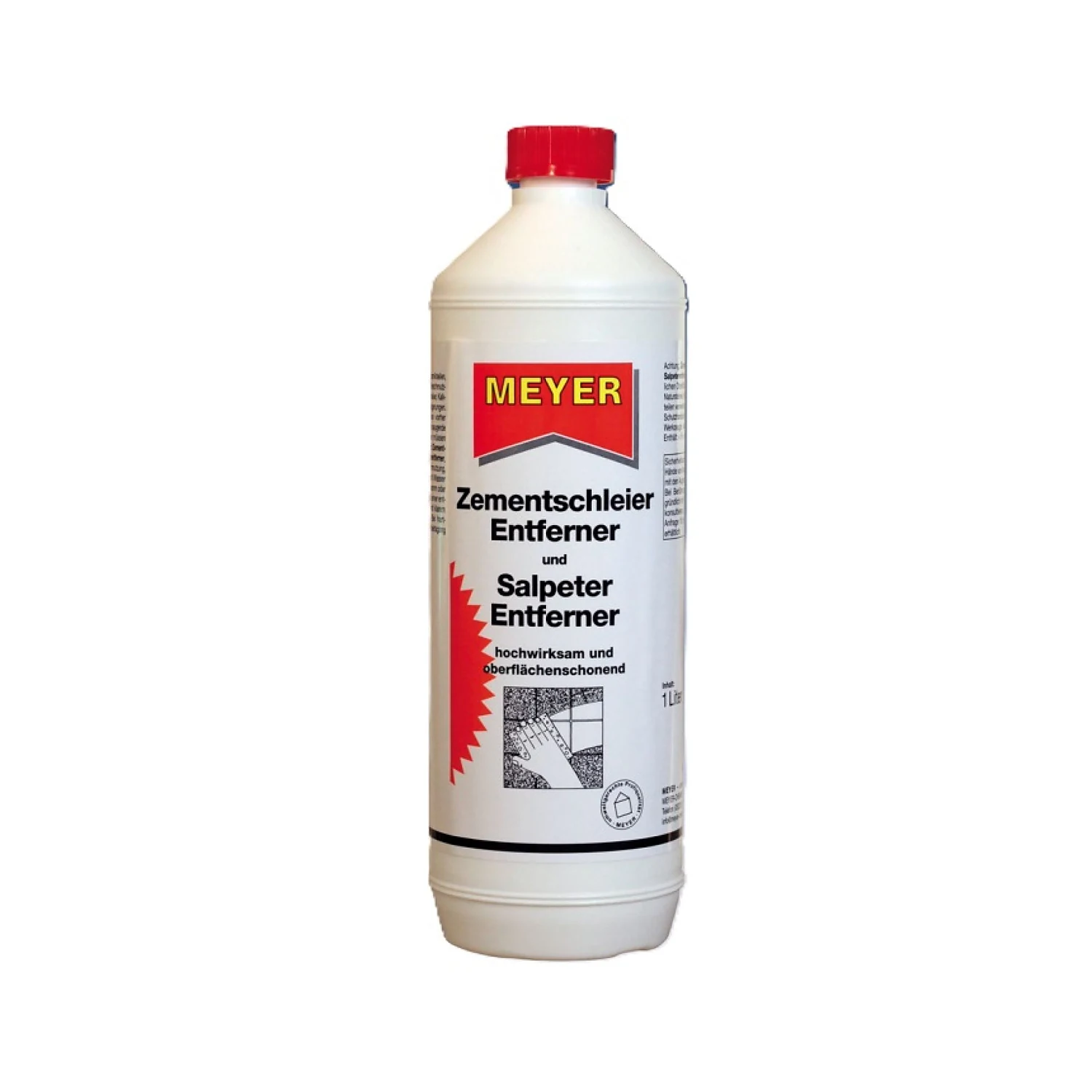
| Meyer cement haze remover | acidic | Cement haze and limescale on tiles | Works immediately against encrustations · 500 ml |
| Meyer sticker remover | pasty | Labels and adhesive residue | Clings to vertical surfaces · cloudy colouring · 150 ml |
| Meyer bioethanol 96 % | Ethyl alcohol | Ethanol fireplaces and decorative fires | Burns smoke-free and soot-free · 96 vol. % · 1 l |
Cement haze cannot be wiped away
After grouting, a wafer-thin, milky film of cement constituents remains on the tile. It is not dirt lying on top but a mineral layer bonded to the surface – which is why wiping with water achieves nothing, no matter how often. What helps is an acid that chemically dissolves the cement constituent.
What tradespeople use Meyer-Chemie for
- Treating beams and roof trusses against woodworm and house longhorn beetle
- Sealing and refreshing wood with linseed oil varnish
- Using linseed oil varnish as an additive in primers
- Removing old and painted-over wallpaper
- Removing cement haze after grouting
- Dissolving limescale deposits on tiles
- Removing labels and adhesive residue without leaving a trace
- Operating ethanol fireplaces and decorative fires
Meyer-Chemie product families
Good to know
- In Enger since 1956. Martin Meyer founded the company as a small manufacturer and supplier of painters' products; today it is run by Matthias and Dr. Thomas Meyer.
- Family business in the Herford district. The headquarters are at Werkstraße 13 in 32130 Enger, between the Wiehengebirge and the Teutoburg Forest.
- Three brand lines. Besides “MEYER”, the company, by its own account, runs the brands ALGOREX and MEYER household products; it also does contract filling for other manufacturers.
- Linseed oil varnish calls for caution with rags. Cloths and steel wool soaked in linseed oil can heat up by themselves as they dry. The safety information on the container describes the correct disposal – here it is no formality.
- Wood preservatives are biocidal products. Application, protective equipment and ventilation are stated on the label and in the safety data sheet. With load-bearing components an infestation belongs in the hands of a specialist firm.
- Source of the company information: meyer-chemie.de, legal notice and company profile, retrieved on 17 September 2026.
Frequently asked questions about Meyer-Chemie
How do I recognise fresh woodworm infestation?
By light, fine boring dust lying under the hole or trickling out of it – with old, finished infestation the dust has turned grey and hardened. The holes themselves say little: they are exit holes of the adult beetles and can be decades old. Anyone who wants to be sure sticks paper under the spot and checks after a few weeks. With load-bearing components, suspected house longhorn beetle or large-area infestation the assessment belongs in expert hands.
How do I apply the wood preservative?
According to the product data, Meyer Holzwurm EX is liquid and is applied with a brush or syringe, 200 grams per square metre being specified. The usual approach is a generous application in several passes and flooding the exit holes in a targeted way so that the agent runs into the galleries. Raw, untreated wood is treated – on painted or glazed surfaces nothing penetrates. The instructions for use on the container are binding.
On which coverings must the cement haze remover not be used?
On acid-sensitive surfaces: marble, limestone and many other natural stones, as well as bare and coated metals. Ceramic and porcelain stoneware tolerate it. Before use a test on a hidden spot is needed, and the grout mortar should have cured through. After the contact time, rinse thoroughly with clear water so that no acid residues remain in the joint.
What is linseed oil varnish used for?
For sealing and refreshing wood and as an additive in primers. According to the product data, Meyer linseed oil varnish is double-boiled, resin-free and mixed with driers that accelerate drying through – pure linseed oil takes considerably longer for this. How the working materials are handled is important: soaked rags and steel wool can heat up by themselves as they dry and should be spread out or disposed of in a closed metal container.
Range by Meyer-Chemie

Content: 0,5 Litre (€13.90 / 1 Litre)


2 variants
Content: 0,25 Litre (€11.16 / 1 Litre)

Content: 0,75 Litre (€34.60 / 1 Litre)

2 variants

Content: 0,15 Litre (€23.27 / 1 Litre)
Manufacturer information pursuant to Art. 19 EU GPSR
Postal address
Meyer-Chemie GmbH & Co. KG
Werkstraße 13
32130 Enger
Germany
Electronic address info@meyer-chemie.de
Information as of: 2026-09-17
More brands
 OTTO Chemie
208 items
Sealants and adhesives from Upper Bavaria – the OTTOSEAL range for sanitary, windows and natural stone.
 Schuller Eh'klar
175 items
Austrian family business for painters' tools – brushes, rollers, spatulas and safety equipment in fixed series.
 Soudal
82 items
Belgian manufacturer of PU foams, hybrid adhesives and wood glues for window, door and timber construction.
 Düfa
37 items
Paint and varnish brand of Meffert AG from Bad Kreuznach – primers, water-based varnishes, wall and façade paints.
 Sika
28 items
Swiss specialty chemicals for bonding, sealing and waterproofing in construction.
 Kip
16 items
Adhesive tape manufacturer from Bocholt – masking, protective and cloth tapes for painters and plasterers.