
How to Paint a Facade – Step by Step

Contents
What you need
Project template “Clean and protect the façade”By Baustoffheld · Specialist trade for building materials, Kevelaer · As of November 2026
How to paint a facade: Clean the wall thoroughly, remove algae and green growth, and let the render dry. Prime where your paint's data sheet requires it, especially on absorbent render, tape off windows and joints, and then paint twice: first with no more than 10% water added, then undiluted or with no more than 5% water. Only paint from +5 °C, not in direct sun, in rain, fog or strong wind. A silicone resin paint such as the Düfa D150 or a siloxane paint such as the Düfa D137 needs about 170 ml per square metre and coat on smooth render.

Unlike indoors, the weather plays a role on the facade, and the substrate must be right beforehand. All values below come from the technical data sheets of the facade paints we stock.
Shopping list
Basic set (always required)
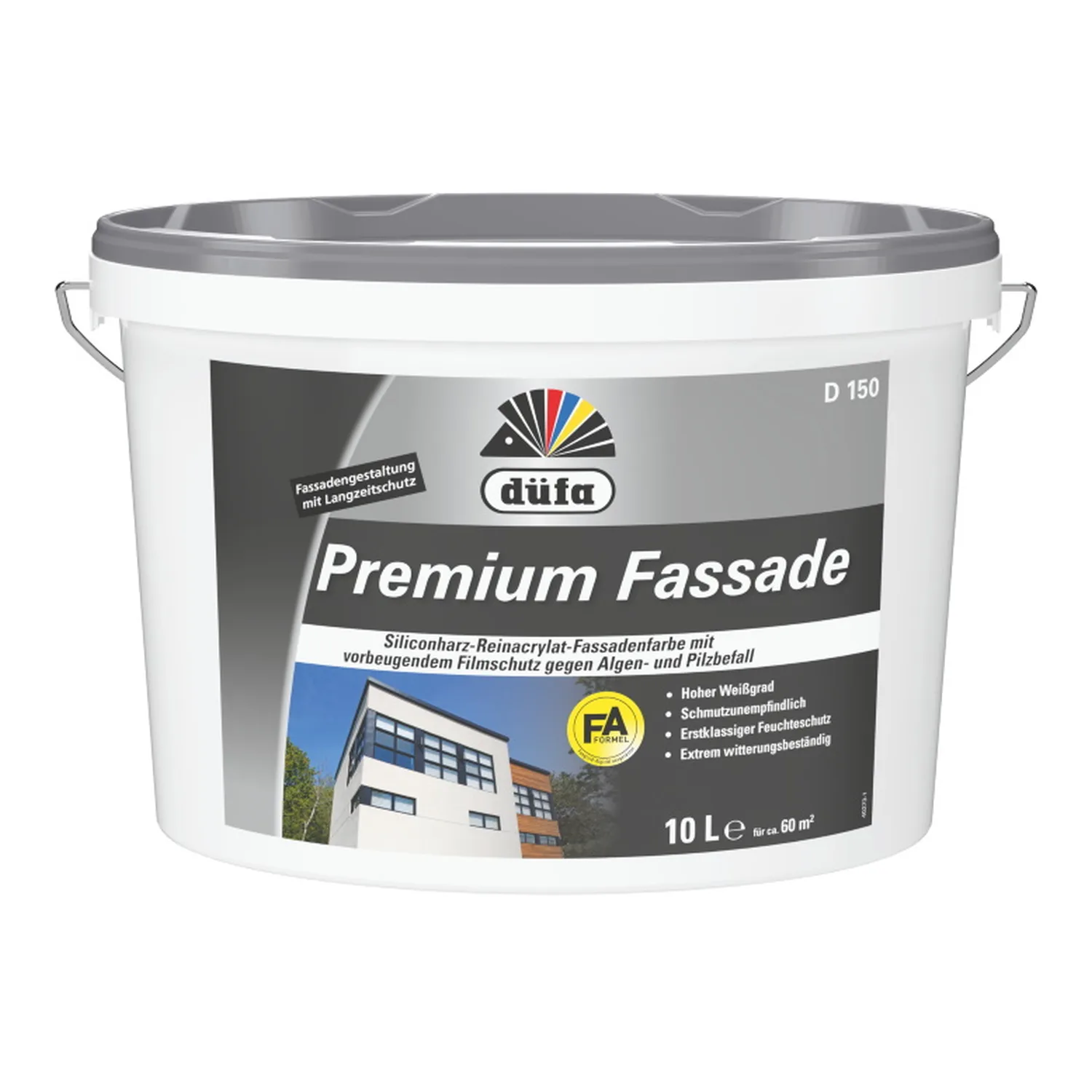
Düfa D150 Premium White
Silicone resin, water permeability W3, with film protection against algae and fungi. 2.5 l, 5 l or 10 l.
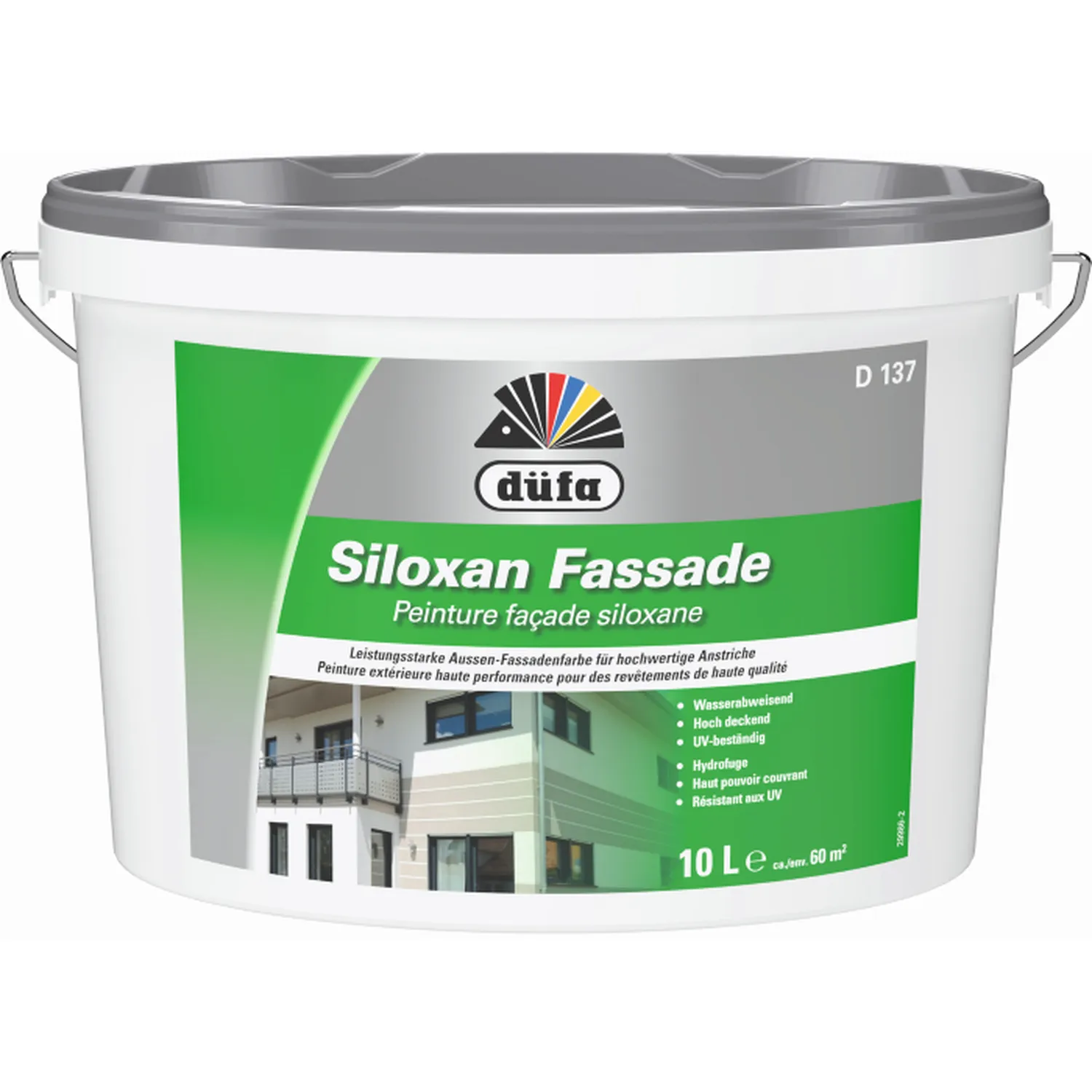
Düfa D137 Siloxane Facade
Acrylic dispersion with siloxane, water permeability W2, in a 10 l bucket.
- Masking tape for outdoor use: Birtel Goldband ECO UV masking tape
- Dust sheet for floors, flower beds and paths: Birtel dust sheet
- Brush for edges and reveals: Schuller Allround facade brush 75 mm
- Paint grid for the paint bucket
Optional – depending on the facade
- For algae and green growth: Glutoclean green growth remover and a pressure sprayer (Mesto 3237P)
- Against algae and fungi in the new coat: Düfa D111 paint additive for the facade paint
- For the plinth: Düfa D231 plinth paint, scrub-resistant
- For breakouts in concrete and masonry: Soudal Cement Repair Express
- For high areas: extendable paint pole (0.77 to 3.00 m) and a paint roller with 18 mm pile
You will find all products for cleaning and algae protection under facade cleaners and green growth removers.
Which facade paint is right?
Both paints are matt, white, vapour-open (class V1) and can easily be tinted with no more than 3% tinting colour. The difference lies in protection against driving rain.
| Feature | Düfa D150 Premium White | Düfa D137 Siloxane Facade |
|---|---|---|
| Binder | Silicone resin / pure acrylate | Acrylic dispersion with siloxane |
| Water permeability (DIN EN 1062) | W3, low | W2, medium |
| Water vapour permeability | V1, sd below 0.14 m | V1, sd below 0.14 m |
| Protection against algae and fungi | Film protection included | no information given, can be fortified with Düfa D111 |
| Pack sizes | 2.5 l, 5 l, 10 l | 10 l |
| Coverage per coat | approx. 170 ml/m² | approx. 170 ml/m² |
| Recoatable | after 4–6 hours | after 4–6 hours |
Our recommendation: For exposed walls, houses close to trees or without a generous roof overhang, choose the D150, as it resists driving rain better and already includes film protection. For sheltered facades and large areas, the D137 in the 10 l bucket is sufficient. Paint the plinth with the scrub-resistant D231.
How much paint do I need?
Allow about 170 ml per square metre per coat, so roughly 0.34 litres for two coats. For 100 m² of smooth render you will therefore need about 34 litres. Rough render absorbs considerably more. The manufacturer recommends determining the exact consumption on a test area. Our paint calculator works out the amount for your area.
Step by step
Choose the weather and timing
The surface and the air must be at least +5 °C during painting and while the paint dries. Do not paint in direct sun, in rain, in damp fog or in strong wind, and watch out for night frost.
Why: Paint that dries too quickly or too slowly adheres less well and can show lap marks. Check: No rain or frost is forecast for the day of painting or the night after.
Check the facade
Run your flat hand over the wall. If white dust sticks to your hand, the old coat is chalking and must be brushed or washed off. Scrape off loose or flaking paint.
Why: New paint is only as good as the layer underneath. Check: Your hand stays clean and nothing flakes.
Clean and remove algae
Brush off dirt or clean it with a pressure washer. For an external thermal insulation composite system (ETICS), a maximum of 60 °C and 60 bar applies. Treat green growth with the Glutoclean green growth remover: spray or brush it on undiluted and leave it to act for at least 24 hours. One 5 l canister is enough for about 50 m². Then rinse the surface with water, as painting may only start after that.
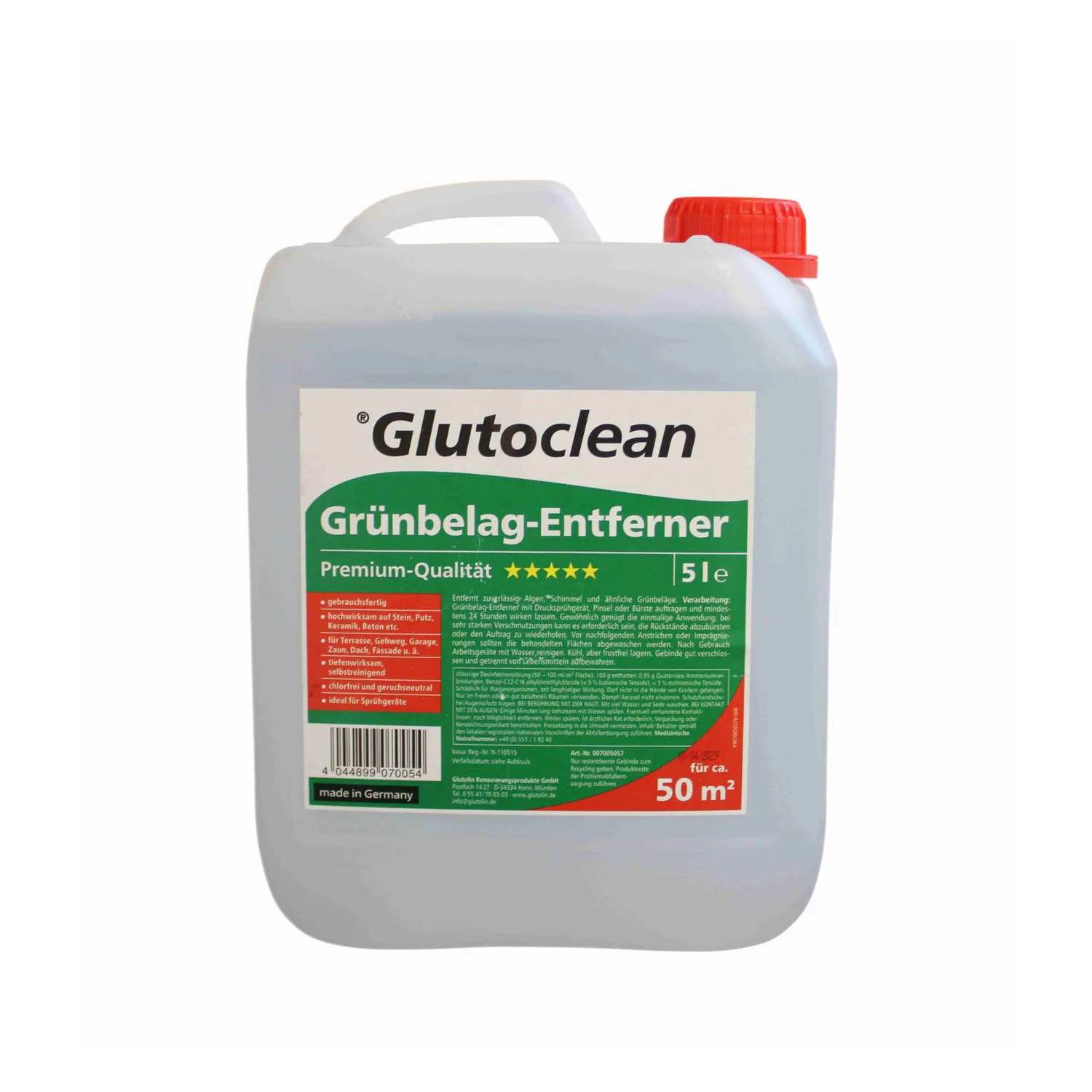
Why: Living algae beneath the new paint will keep growing. Check: No green patches remain and the surface is dry again.
Repair damage
Fill breakouts and cracks in concrete and masonry with Soudal Cement Repair Express. According to the data sheet, hairline crazing in render up to 0.1 mm requires a crack-bridging primer paint.
Check: The repairs are firm and fully dry.
Prime where necessary
Start with the water drop test: if water soaks in instantly in some spots and hardly at all in others, the substrate is absorbing unevenly. What needs priming depends on the paint. For the D137, prime heavily or unevenly absorbent old coats and render with Düfa D 314 Tiefgrund LF or D 316 Tiefgrund plus; firm, low-absorbency old coats need no primer. For the D150, the data sheet specifies Düfa D 320 Silicon Tiefgrund LF for old coatings, render and absorbent masonry, and a solvent-based primer for coarsely porous or sanding surfaces. We do not currently stock these primers in the shop, so feel free to ask us.
Why: Render that absorbs unevenly draws the paint away in patches. Check: The primer has dried according to the manufacturer's instructions before you paint.
Mask off
Carefully tape off windows, doors, window sills and everything made of glass, ceramic, clinker, natural stone, metal and wood. Outdoors, the UV-resistant Goldband tape holds, while the dust sheet protects the floor and flower beds. Wipe off paint splashes immediately with clean water.
Paint twice
Stir the paint thoroughly. Dilute the first coat with no more than 10% water and apply the second coat undiluted or with no more than 5% water. First brush the edges and reveals with the facade brush, then roll the main area, and work through each wall section without a break to avoid lap marks. If you want to make the D137 algae-resistant, first stir 250 ml of Düfa D111 into 10 litres of paint. For areas that belong together, use paint from the same batch.
Check: The second coat covers evenly and nothing shows through.
Drying times
At 20 °C and 65% relative humidity, according to the data sheet. In cold or high humidity, it takes longer.
| Product | Recoatable | Fully dried | Check |
|---|---|---|---|
| Düfa D150 | after 4–6 hours | after approx. 3 days | surface no longer tacky |
| Düfa D137 | after 4–6 hours | after approx. 3 days | surface no longer tacky |
| Düfa D231 | after approx. 4 hours | after approx. 3 days | surface no longer tacky |
| Glutoclean | at least 24 hours to act | – | surface rinsed and dry |
Common mistakes – and how to avoid them
- Diluted too much: More than 10% water in the first coat or 5% in the second makes the paint thin. It covers less well and lasts for a shorter time.
- Painted in evening dew: If dew or rain falls on fresh paint, yellowish glossy run marks can appear. According to the data sheet, rain usually washes them off within 12 months. Under a roof overhang they remain visible for longer.
- Algae painted over: Without pre-treatment, the green growth will return.
- Repaired with a different batch: Areas you touch up later will show to a greater or lesser degree depending on the facade. Use the same paint, the same batch and the same tools.
- Acrylic joints painted over: On acrylic sealant, the paint may crack or discolour.
Frequently asked questions
How often do I need to paint a facade?
Twice. The first coat is slightly diluted, the second is applied undiluted. Only then does the paint reach the film thickness that protects the facade.
Which paint is best for the facade?
For exposed walls, a silicone resin paint with water permeability W3, such as the Düfa D150, is the stronger choice. For sheltered surfaces, a siloxane paint such as the Düfa D137 is sufficient.
Can I repaint the facade without removing the old coat?
Yes, if the old coat adheres firmly and does not chalk. Both Düfa paints are intended for painting over firm dispersion old coats. Loose paint must be removed beforehand.
When is the best time to paint the facade?
When the temperature is at least +5 °C both day and night and a few dry days without blazing sun follow. This is usually the case between spring and early autumn.
How much facade paint do I need for 100 m²?
For two coats on smooth render, about 34 litres. On rough render, more. Create a test area.
Do I need a primer?
It depends on the paint and the substrate. For the D137, only on heavily or unevenly absorbent surfaces; for the D150, according to the data sheet, on old coatings, render and absorbent masonry. The data sheet for the paint names the suitable primer.
Further reading
Basic set: facade paint and masking materials

3 variants
Content: 5 Litre (€13.60 / 1 Litre)

Content: 10 Litre (€11.00 / 1 Litre)

5 variants
Content: 50 Metre (€0.04 / 1 Metre)


Optional – depending on the facade

Content: 5 Litre (€3.39 / 1 Litre)


Content: 0,25 Litre (€39.56 / 1 Litre)

4 variants
Content: 5 Litre (€14.00 / 1 Litre)

Content: 0,3 Litre (€30.97 / 1 Litre)


Matching calculator
More guides on this topic
All guides on “Wood, paint and façades” Comparison
Guide: GORI 33 or GORI 88 – which wood stain suits your project?
GORI 33 or GORI 88: thin-film or medium-film wood stain for which timber component
 Problem solving
Guide: brown stains in wall plaster – finding and fixing the cause
Where brown stains in fresh plaster come from and how barrier primer blocks them permanently
 Instructions
Guide: refreshing, cleaning and caring for WPC decking
Clean WPC decking, refresh its colour and impregnate it, with a realistic care plan