
Which PU foam for window installation? 1K and 2K compared

Contents
What you need
Project template “Door frame and installation with PU foam”Short answer: for the one-off installation of a single window, a 1K hand foam with an applicator straw such as the Birtel assembly foam 500 ml is enough – cheap and dimensionally stable enough for DIY use. Anyone fitting several windows one after another, working independently of humidity and wanting to move on quickly reaches for a 2K fast foam such as the Soudal Soudafoam B2: it can be cut after around 20 minutes. Both foams belong to building material class B2 and must be protected from UV radiation once cured.
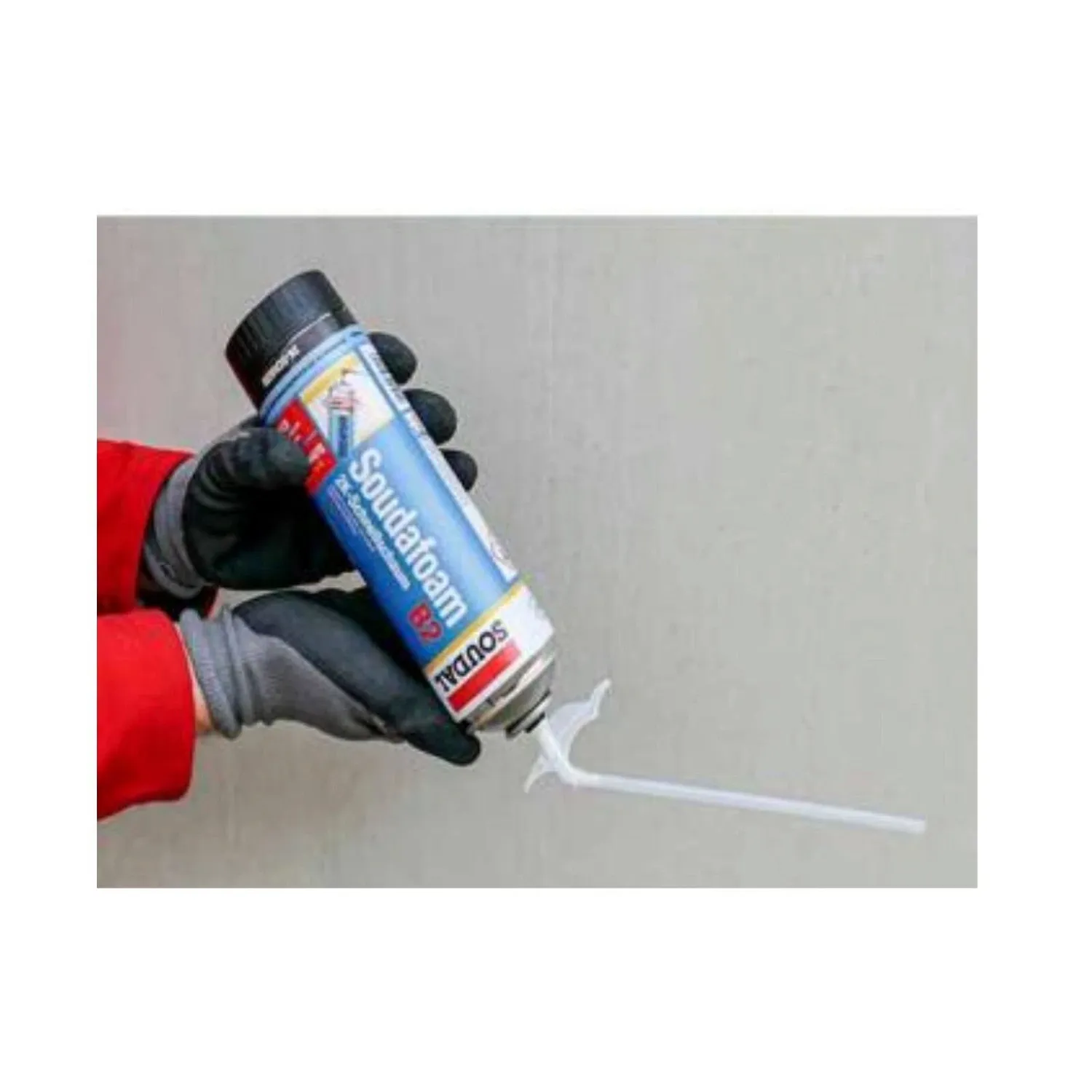
During window installation, PU foam fills the middle insulation level between the outer frame and the masonry. There are essentially two technologies to choose from: 1-component (1K) foam, which cures with the humidity in the air, and 2-component (2K) foam, which sets quickly through the mixing of two reaction partners, independently of the weather. Which variant makes sense for your project depends above all on the number of windows and the working pace you want.
The two candidates compared directly

Birtel assembly foam 500 ml (1K)
1-component foam with an applicator straw included – no gun needed. Excellent adhesion on almost all building substrates (except PE, PP, PTFE, silicones), tested building material class B2 (DIN 4102-1, test certificate P-SAC 02/IV-010). Ideal for a single window or door frame in a DIY project.
Go to the product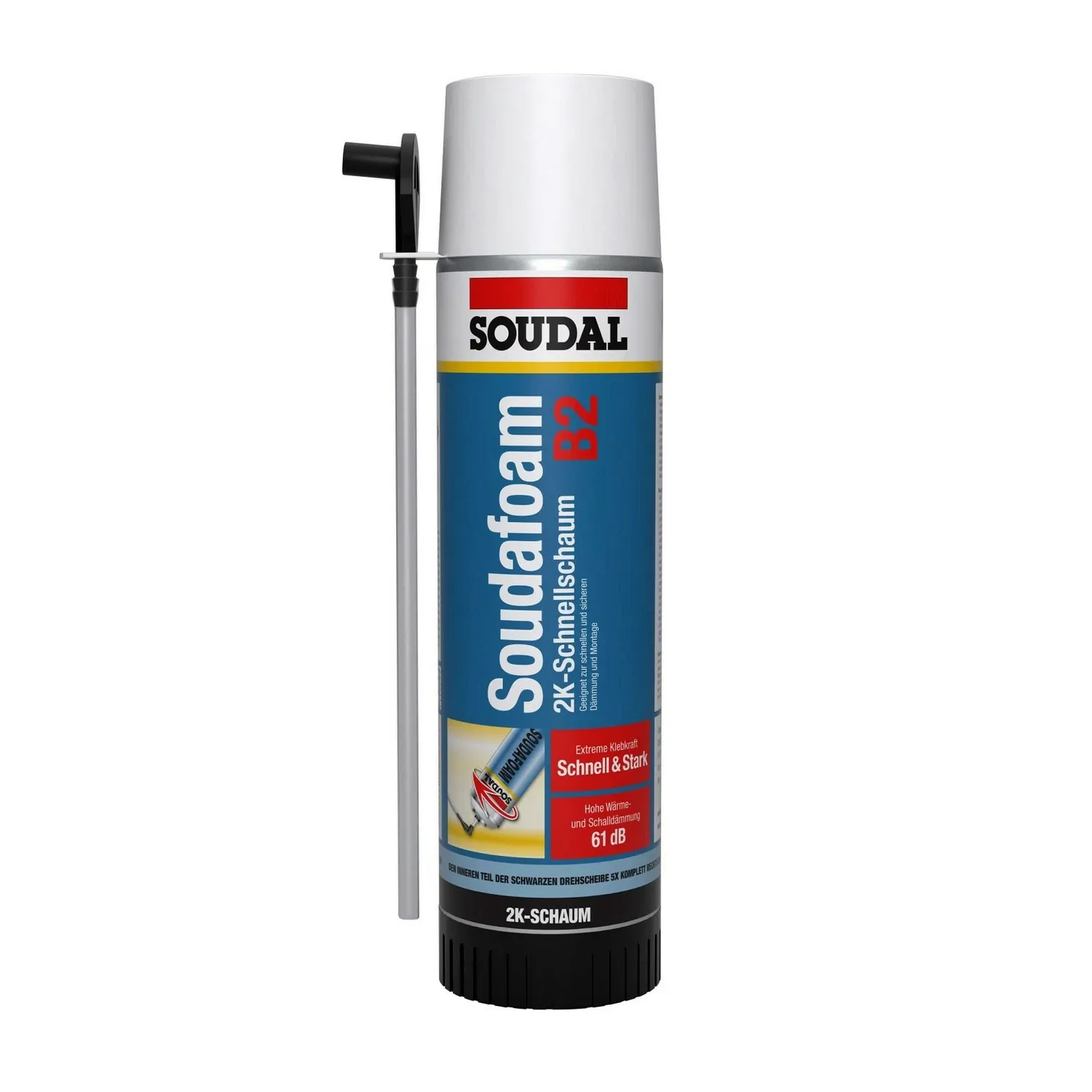
Soudal Soudafoam 2K assembly foam B2, 400 ml
2-component fast foam, cures independently of the humidity in the air and can be cut after approx. 20 minutes. Dimensionally stable with no shrinkage or post-expansion, likewise building material class B2 (DIN 4102-1). The ideal choice for several windows or when things have to move fast.
Go to the productDetailed comparison
| Feature | Birtel assembly foam 500 ml (1K) | Soudal Soudafoam 2K B2, 400 ml |
|---|---|---|
| Components | 1K – cures with humidity in the air | 2K – chemical reaction, independent of humidity |
| Can be cut after | After it has cured right through | approx. 20 minutes |
| Application temperature | +5 °C to +30 °C (optimum 15–25 °C) | +5 °C to +35 °C substrate, +15–25 °C can |
| Fill the joint to | approx. 1/3 (it expands further after leaving the can) | approx. 50 % (it foams further after leaving the can) |
| Dimensional stability | No shrinkage, slight post-expansion after curing | No shrinkage, no post-expansion after curing |
| Supplied as | 500 ml aerosol can with applicator straw | 400 ml aerosol can, enough for 1–2 door frames |
| Building material class | B2 to DIN 4102-1 | B2 to DIN 4102-1 |
| UV resistance | No – paint over or seal | No – paint over or seal |
| Best suited to | A single window or door frame, occasional use | Several windows, series installation, moving on quickly |
Our recommendation by use case
If you are fitting only a single window or one door frame and have time to let the foam cure overnight, the 1K hand foam with a straw is the more economical choice – it needs no extra equipment. If you are fitting several windows in one day or want to carry on working the connection joint promptly (fitting sealing tapes, plastering), the 2K fast foam plays to its strengths: curing independently of the weather and cuttable after only 20 minutes. How to apply the foam you choose cleanly is shown by the guide Applying PU foam properly; what to do if the foam stays tacky is under PU foam will not cure.
Further options for fitting windows and doors
For professionals with a gun: Biwa gun foam 750 ml
1K gun foam with a sound insulation test certificate up to 58 dB and a yield of approx. 45 litres per can – more precise dosing than hand foam and less material lost on repeat jobs. All gun foams at a glance.
For door frames at speed: Soudal 2K frame foam 210 ml
A 2K cartridge with a static mixer for the 2K cartridge gun, cuttable after approx. 5 minutes. One cartridge is enough for 1–2 door frames. All assembly foams with a straw at a glance.
Common questions about PU foam for window installation
What is the difference between 1K and 2K PU foam?
1K foam cures through the humidity in the air and therefore takes somewhat longer to cure right through. 2K foam consists of two components that react chemically with each other as they leave the can – it therefore cures independently of the humidity and considerably faster, with the Soudal Soudafoam B2 already cuttable after around 20 minutes.
How far may I fill the window joint with PU foam?
With the Birtel assembly foam only to about a third, with the Soudal Soudafoam 2K to about half – both foams expand or foam further after leaving the can.
Does cured PU foam at the window joint have to be protected?
Yes. Both of the foams compared here are not UV-resistant and should be painted over once cured or sealed with a sealant such as silicone, polyurethane, acrylic or MS polymer.
At what temperature can I apply PU foam during window installation?
The Birtel assembly foam is suitable for +5 °C to +30 °C (optimum 15–25 °C). The Soudal Soudafoam 2K tolerates +5 °C to +35 °C at the substrate, and the can itself should be +15 °C to +25 °C warm.
Is PU foam alone enough for a RAL-compliant window installation?
No. PU foam takes care of the insulation in the middle level; for an installation that complies with the standard, an inner and an outer connection level with sealing tapes or membranes are added. The full sequence is shown by our guide: RAL window installation – sequence and materials.
Which foam is suitable for several windows in one day?
For series installation the 2K foam is recommended, as it cures quickly and dimensionally stably regardless of the humidity and lets you carry on promptly. Alternatively a gun foam such as the Biwa gun foam 750 ml with a yield of around 45 litres per can offers high coverage for repeated use.
How do I remove PU foam from the window frame?
Fresh foam can be wiped off with PU cleaner, cured foam can only be cut away mechanically and treated afterwards with a special gel. The details are in our guide Removing PU foam.
Matching calculator
More guides on this topic
All guides on “PU foam, windows and roofs” Problem solving
Guide: PU foam will not cure – causes and fix
Why PU foam stays tacky or collapses and how to repair the connection
 Comparison
Guide: gun foam or hand-held foam – which is better?
Gun foam or hand-held foam: when the foam gun is worthwhile and when not
 Problem solving
Guide: removing PU foam – fresh and cured
Remove fresh PU foam with cleaner, cured foam mechanically and with remover gel