

The short answer: silicone is permanently elastic and permanently water-repellent – the right choice for heavily loaded wet areas such as the shower, bathroom or kitchen, but it cannot be painted over. Acrylic can be painted over and is therefore ideal for quiet connection joints in interior fit-out, but it takes far less movement and no permanent wetness. Proven professional products: OTTOSEAL S105 (sanitary silicone) and OTTOSEAL A205 (premium acrylic sealant).

The quick decision: silicone or acrylic?
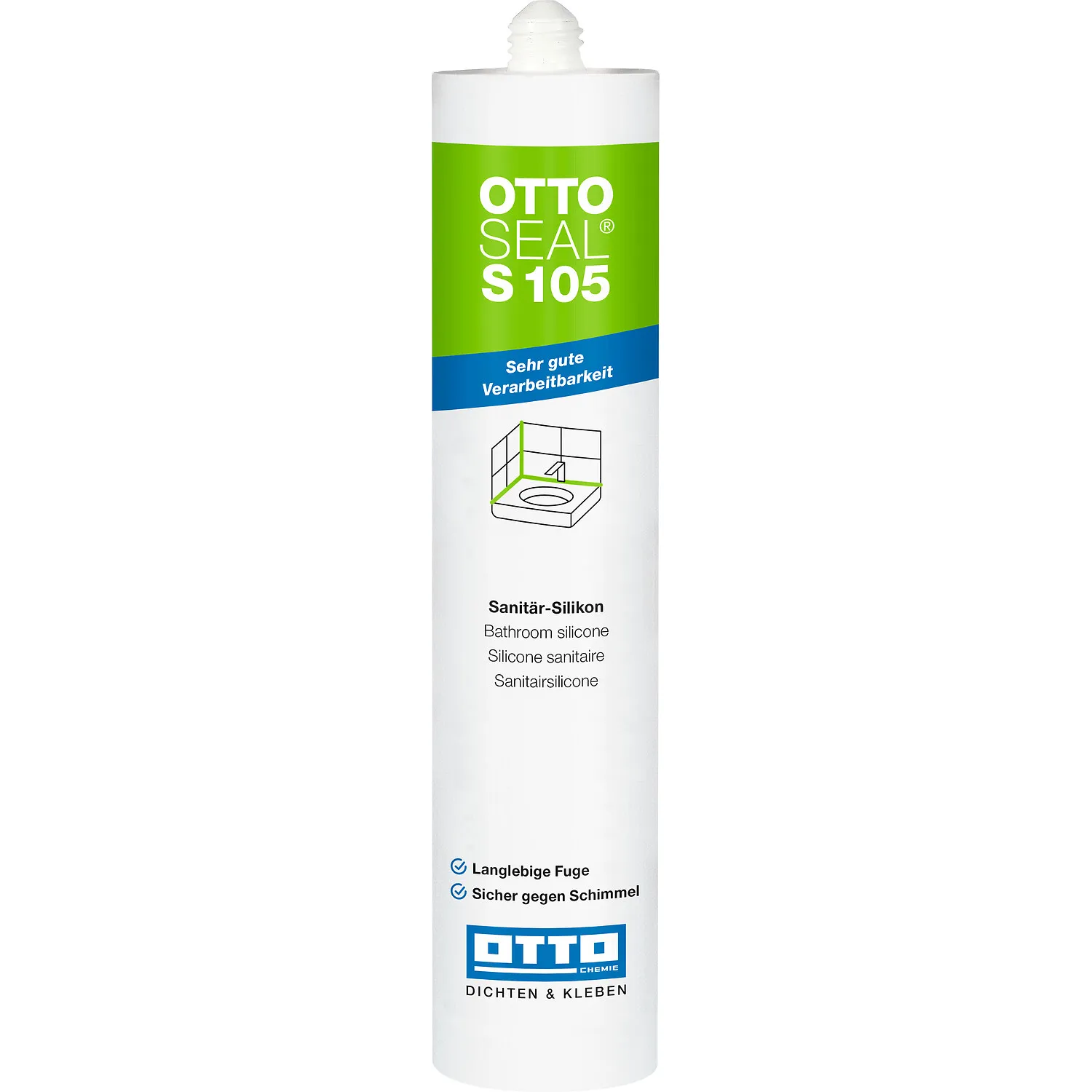
OTTOSEAL S105 Silicone
- Acetoxy-curing 1K silicone with a fungicidal additive
- Resistance to mould growth
- Very good weathering, ageing and UV resistance
- Permanently elastic, water-repellent – suitable for permanent wetness
- 17 shades, but cannot be painted over

OTTOSEAL A205 Acrylic
- 1K acrylate sealant, low-odour
- Permissible total deformation 18 %
- Paint-compatible to DIN 52452
- Temperature-resistant from -20 °C to +80 °C
- Recommended for indoor living environments, but not for permanent wetness
Why the difference matters so much
After application, silicone vulcanises into a permanently elastic rubber. This closed, slightly hydrophobic surface makes the joint permanently water-repellent and able to take up movement – exactly what connection joints at a shower tray, basin or tiles need. The drawback: no paint adheres to that surface, silicone always stays visible. Acrylic, by contrast, is a water-based 1K sealant that stays porous enough after drying for emulsion paint to hold on it – ideal when the joint is meant to disappear into the wall. In return, acrylic takes considerably less movement (with OTTOSEAL A205 a maximum of 18 % total deformation) and is not permanently impermeable to water, which is why it is out of the question in wet areas with standing moisture. You will find suitable products in the categories sanitary silicone and acrylic sealants.
The comparison in detail
| Criterion | Silicone (OTTOSEAL S105) | Acrylic (OTTOSEAL A205) |
|---|---|---|
| Material base | Acetoxy-curing 1K silicone | 1K acrylate sealant, water-based |
| Movement capability | Up to 25 % (EN 15651 part 1: F EXT-INT CC 25 LM) | 18 % permissible total deformation |
| Can be painted over | No | Yes, to DIN 52452 – with little joint movement, only after at least 1 week of drying |
| Water resistance | Permanently water-repellent, suitable for permanent wetness | Only conditionally water-resistant, not for permanent wetness |
| Standards & tests | EN 15651 parts 1–3, IVD guidance note no. 3-1+3-2+14+31+35, EMICODE EC1 Plus, French VOC class A+ | Recommended for indoor living environments, IVD guidance note no. 16, DIN 52452 |
| Application temperature | +5 °C to +35 °C | From +5 °C, surface skin after approx. 2 hrs (23 °C / 50 % RH) |
| Typical use | Bathroom, shower, kitchen, floor and wall joints, profiled glass | Connection joints of window and door frames to masonry, plaster, concrete; interior fit-out |
| Shades | 17 shades | White (special colours on request) |
Special case: acrylic that can be painted over at once
If you do not want to let the joint dry for a week first, OTTOSEAL A220 is an alternative: this painter's acrylic is developed specifically for painting over immediately, and in return takes less movement than the A205 at 10 % total deformation. For quiet, lightly loaded connection joints in interior fit-out it is nonetheless a practical solution when things have to move fast.

At the window: acrylic or silicone?
Indoors, on a connection joint that will be painted, acrylic or a paintable hybrid sealant belongs. Outdoors and on the weather side it does not: acrylic is not permanently water-resistant. There a neutral-curing, UV- and weather-resistant silicone belongs in the joint, and with timber windows a hybrid sealant is better. For the building connection joint the rule “tighter inside than out” also applies. The details per window type, on the glazing rebate and on the window sill are in the guide Which silicone for windows.
Common questions about silicone and acrylic
Can I paint over silicone joints?
No, conventional silicone cannot be painted over. Our guide Painting over silicone explains the details and the alternatives.
What is acrylic not suitable for?
Acrylic is not permanently water-resistant and therefore unsuitable for wet areas with standing moisture such as the shower. There a fungicidal sanitary silicone belongs in the joint – more on that in the guide Which silicone for the shower?
How much movement does acrylic take compared with silicone?
OTTOSEAL S105 takes up to 25 % total deformation according to EN 15651 part 1, OTTOSEAL A205 by contrast only 18 %. For joints with a lot of movement, silicone is therefore the more robust choice.
Can acrylic also be used outdoors?
OTTOSEAL A205 is intended primarily for interior fit-out, but at temperatures above +5 °C it can readily be used outdoors as well – on window sills or roller shutter boxes, for instance.
Why does my silicone joint in the bathroom turn black?
That is usually mould growth caused by standing water and soap residue. The guide Preventing and removing mould in silicone joints explains the causes and the fixes.
Do I need a primer for acrylic?
On strongly absorbent or very smooth substrates a primer improves adhesion. On absorbent mineral substrates a mixture of acrylic sealant and water in a ratio of 1:2 helps instead.


