
OTTOSEAL S67 or S69 – which cleanroom silicone?

Contents
What you need
Quantities adjustableThe short answer: Both silicones are approved for cleanrooms, manufacturing rooms and ventilation (HVAC) systems and carry the same tests. The practical difference lies in the product labelling: the S67 is designed for excellent adhesion to metal and is available from us in eight colours and additionally in the 580 ml foil bag – the first choice for plant engineering and electronics and chip manufacturing. The S69 is harmless in contact with food and therefore the choice for production and filling areas in the food and pharmaceutical industries. Where silicone is undesirable in principle, the silicone-free hybrid M380 comes into play.

Both candidates at a glance

OTTOSEAL S67 cleanroom silicone
Silicone sealant for cleanrooms and manufacturing rooms with high hygiene requirements. According to the product labelling with excellent adhesion to metal, low odour and good chemical resistance.
- 8 colours: stainless steel, grey, manhattan, transparent, RAL 7035, 9002, 9010, 9016
- 310 ml cartridge and 580 ml foil bag
- Fungicidal additives, non-corrosive

OTTOSEAL S69 cleanroom silicone
Same fields of application, same tests – but according to the product labelling harmless in contact with food, low odour and with good chemical resistance.
- 4 colours: stainless steel, transparent, RAL 9002, RAL 9010
- 310 ml cartridge
- Fungicidal additives, non-corrosive
Comparison table: S67 versus S69
| Feature | OTTOSEAL S67 | OTTOSEAL S69 |
|---|---|---|
| Basis | Silicone | Silicone |
| Highlighted feature | Excellent adhesion to metal | Harmless in contact with food |
| Odour | low odour | low odour |
| Chemical resistance | good | good |
| Fungicidal additives | yes | yes |
| Corrosion on unprotected metal | non-corrosive | non-corrosive |
| Colours in the shop | 8 (incl. manhattan, grey, RAL 7035, RAL 9016) | 4 (stainless steel, transparent, RAL 9002, RAL 9010) |
| Pack size | 310 ml cartridge, 580 ml foil bag | 310 ml cartridge |
| Application temperature | +5 °C to +35 °C | +5 °C to +35 °C |
| Shelf life | 12 months at +5 to +25 °C | 12 months at +5 to +25 °C |
| HVAC systems to VDI 6022 sheet 1 | suitable | suitable |
| VOC emission class (F) | A+ | A+ |
Recommendation by application
Electronics, chip manufacturing, plant engineering
S67. Here joints on sheet metal, profiles and housings are what matters – exactly what the excellent adhesion to metal is declared for. The stainless steel colour makes the joint disappear visually on stainless steel surfaces.
Food and pharmaceutical production
S69. As soon as the joint is in areas where open product is handled, harmlessness in contact with food is the deciding criterion. Everything else – hygiene test, fungicide, HVAC suitability – the S69 brings equally.
Large quantities of joints, many colours
S67. Only the S67 is additionally listed as a 580 ml foil bag – fewer cartridge changes, less waste – and with eight colours also covers RAL 7035, RAL 9016 and manhattan.
The third option: OTTOSEAL M380 when silicone is a nuisance
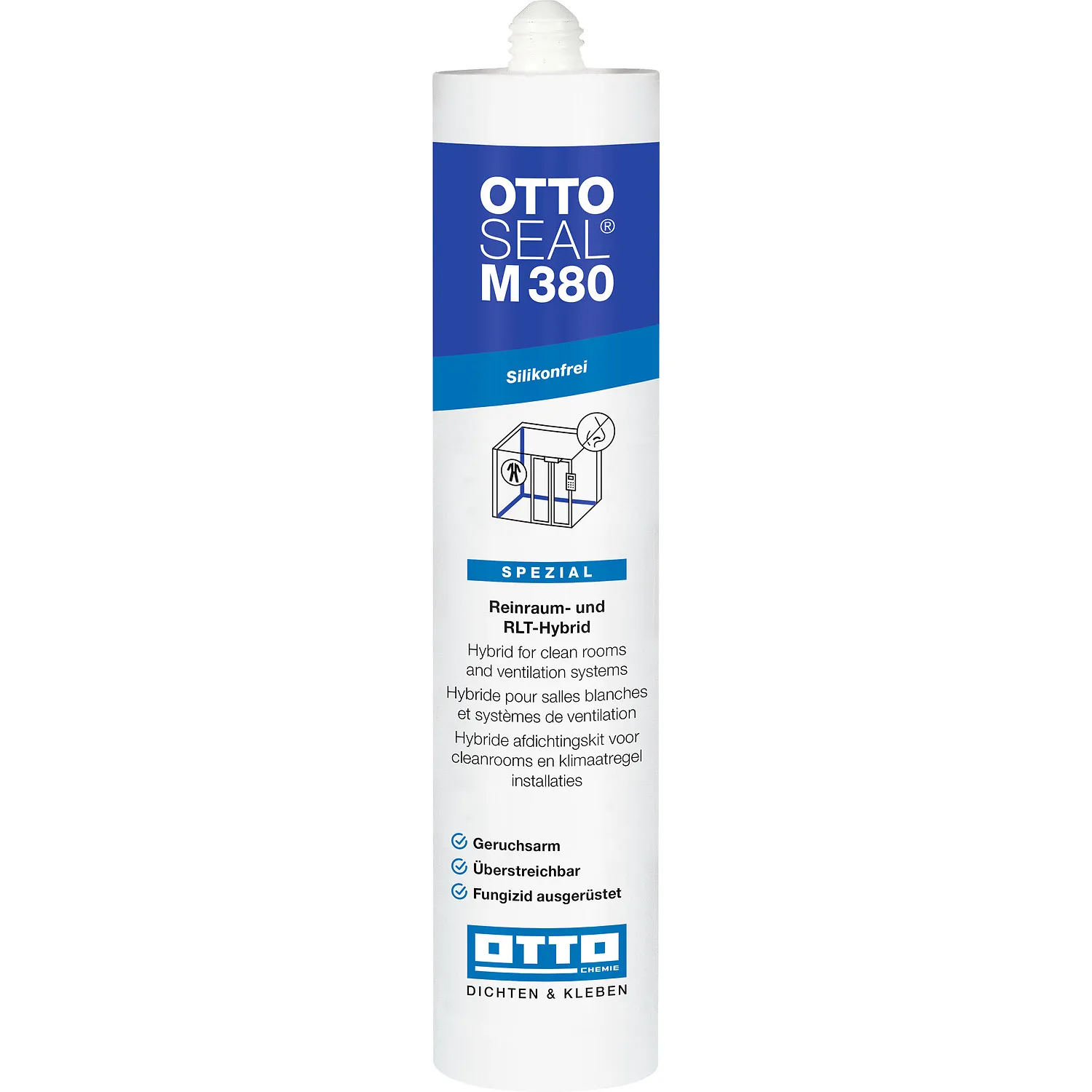
In areas close to painting and coating, traces of silicone are a known problem. For that there is the OTTOSEAL M380 cleanroom and HVAC hybrid: a 1K sealant based on STPU hybrid polymer, silicone-free and free of isocyanates, with fungicidal additives, non-corrosive and likewise tested to VDI 6022 sheet 1 for HVAC systems. It seals and bonds metals such as aluminium, anodised aluminium, brass, copper and stainless steel in a single operation.
The limits matter: The M380 is not suitable for glazing rebate sealing, floor joints, the sanitary and permanently wet area, or where chemicals act on it. Copper under UV and temperature exposure is likewise excluded. The shelf life is at least 9 months, stored cool and dry. More on this class of material in the guide MS polymer – adhesive and sealant explained.
What S67 and S69 have in common
When it comes to approvals, there is nothing to choose between the silicones. Both have been tested by the Hygiene-Institut Gelsenkirchen for applications in the cleanroom sector, are suitable for use in HVAC systems in accordance with VDI 6022, sheet 1 and have been tested to DIN EN ISO 846 in methods A, B and C (Institut für Hygiene, Berlin). Both are suitable for applications in accordance with IVD data sheets no. 31 and 35 and carry the French VOC emission class A+. Typical fields of application are elastic jointing in cleanrooms and manufacturing rooms, production rooms for medicines and other medical articles, and the sealing of ventilation systems.
Application – identical for both
Application temperature +5 °C to +35 °C. Apply with a hand-operated, pneumatic or cordless gun. Tool with smoothing agent and smoothing spatula before a skin forms – later you only draw grooves into the surface. Fresh material can be removed with white spirit, cured material only with silicone remover or mechanically. Unopened packs keep for 12 months from the production date if stored cool (+5 to +25 °C) and dry; opened cartridges belong tightly closed and should be used up promptly. You will find the step-by-step basics in the guide Applying silicone, and quantity planning in the guide Working out silicone usage correctly.
Frequently asked questions
Can I use S67 instead of S69 in food production?
In the shop only the S69 is declared as harmless in contact with food. If the joint is in an area where contact with open food is possible, reach for the S69. For technical, plant and ancillary rooms without product contact the S67 is the more suitable choice.
Do the silicones attack unprotected metal?
No. Both products are declared non-corrosive and cause no (rust) corrosion on unprotected metal surfaces. That is the decisive point with sheet-metal ducts and stainless steel structures – standard acetic-curing silicones have no place there.
Which colour do I take on stainless steel surfaces?
The stainless steel colour – it is available for both the S67 and the S69. If you want a neutral, inconspicuous joint, transparent or RAL 9002 works well. The guide Silicone colours gives an overview of all the colour logic.
When is the 580 ml foil bag worthwhile?
As soon as several linear metres are jointed in one go. The foil bag is listed only for the S67 and needs a matching foil-bag gun. You save cartridge changes and reduce packaging waste considerably.
Are the joints protected against mould?
Both silicones have fungicidal additives and are resistant to mould growth. That does not replace cleaning, however: residue on the joint is a breeding ground. How to clean properly is explained in the guide Cleaning silicone joints.
Can I use S67 or S69 outdoors?
Yes. Both are declared with very good weather, ageing and UV resistance and are intended for long-lasting applications indoors and outdoors. The hybrid M380, by contrast, is expressly not approved for floor joints and the permanently wet area.
You will find the complete range in the category special silicone. For questions about the choice for your project you can reach us on +49 (0) 2831 - 916 77 03.
Matching calculator
More guides on this topic
All guides on “Choosing silicone and sealant” Basics
Guide: MS polymer – adhesive and sealant explained
What MS polymer can do, where it beats silicone, PU and acrylic and where it does not
 Comparison
Guide: OTTOSEAL S100 vs. S105 in detail
OTTOSEAL S100 or S105: differences in colour choice, protection and price
 Comparison
Guide: Ottoseal S70 or S80 – which natural stone silicone for what
Ottoseal S70 or S80: which natural stone silicone for which room and stone