
Removing green growth: terrace, paving and façade clean again

Contents
- Why green growth comes back
- Three ways to remove green growth
- Removing green growth with household remedies: what they are worth
- How to apply the green growth remover
- How much green growth remover do you need?
- Which surfaces is the product suitable for?
- After cleaning: protect or paint the façade
- Frequently asked questions
- Further reading
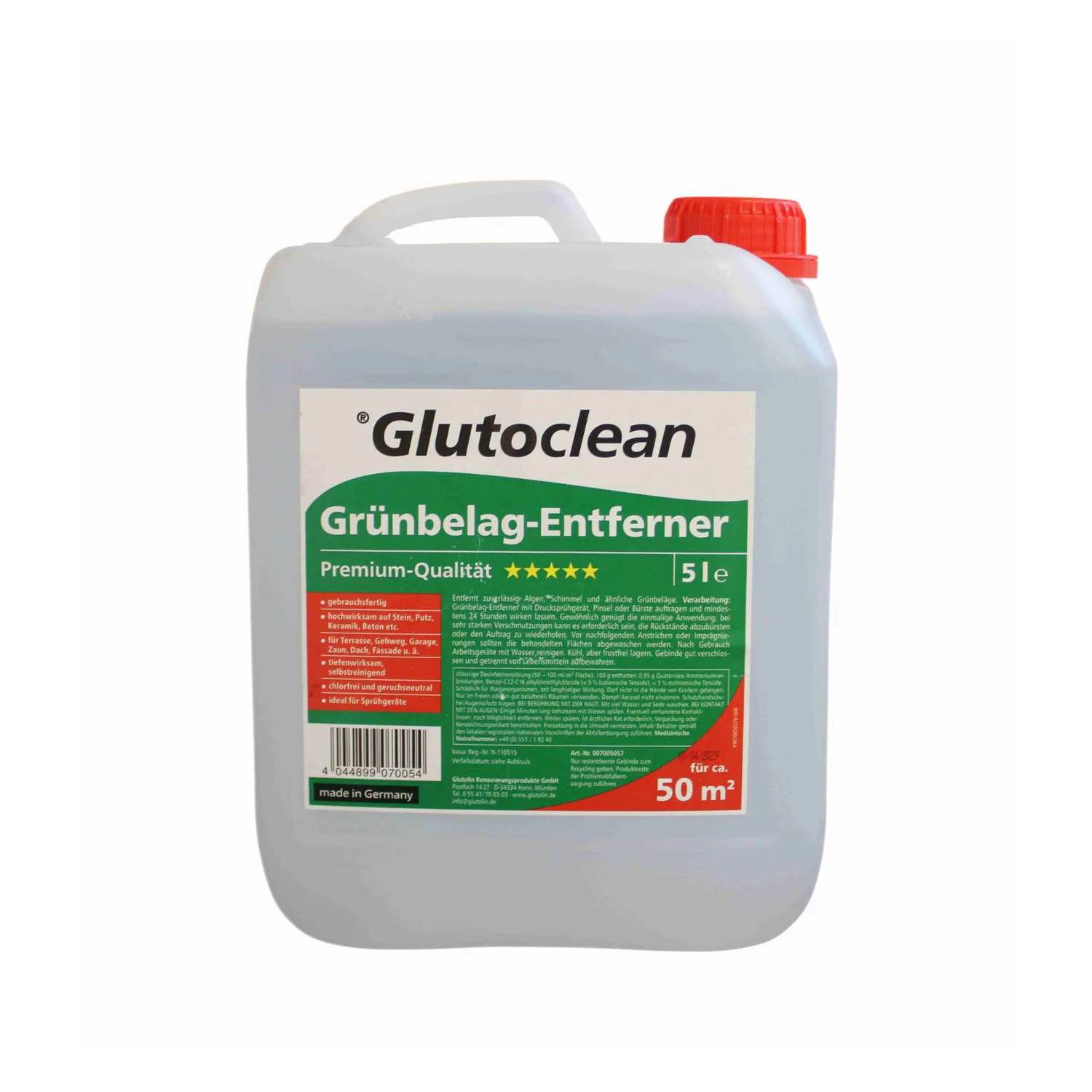
Short answer: The least effort way to remove green growth is a green growth remover that works on its own. You apply it undiluted, leave it to act for at least 24 hours and brush off only stubborn residue. The Glutoclean green growth remover is ready to use, and according to the manufacturer a 5 l jerrycan is enough for about 50 m² of stone, render, concrete or ceramic. On small areas a stiff brush and water will also do. You will find other cleaners under Façade cleaners and green growth removers.
Why green growth comes back
Green growth settles wherever a surface stays damp for a long time: on the north side of the house, under trees, at the plinth and on terrace slabs in the shade. When wet it becomes slippery, so it should not be left on paths and steps. As long as the surface stays damp and shaded, the growth will come back. A method that takes little effort is therefore worthwhile.
Three ways to remove green growth
| Method | Effort | Suitable for | Limitation |
|---|---|---|---|
| Stiff brush and water | High, the whole area is worked by hand | A few square metres, smooth slabs | Growth remains in pores and joints |
| High-pressure cleaner | Medium | Robust, dense surfaces | The jet can roughen soft surfaces and wash out joint sand. On a rough surface new growth takes hold more easily |
| Green growth remover | Low, apply and leave to act | Large areas, rough and porous substrates of stone, render, concrete and ceramic | Only works after at least 24 hours. Residue must not get into gullies or watercourses |
Removing green growth with household remedies: what they are worth
The most reliable household remedy is warm water and a stiff brush. It takes effort, but does not harm any surface.
Vinegar and concentrated vinegar essence contain acid. Acid attacks lime-based stones such as marble and limestone, as well as cement-bound joints.
Salt is carried by rain into the neighbouring flower beds and into the soil. There it harms plants. It is therefore no good as a cleaner for terraces and paths.
Washing soda is often recommended. We have no reliable data on its effect on green growth, so we do not recommend it.
How to apply the green growth remover
1Sweep the surface
Sweep off leaves, soil and loose moss cushions. The product should reach the surface itself, not a layer of dirt.
2Wait for a dry day and put on gloves and goggles
The surface should be dry, and no rain should be forecast for the next 24 hours. Otherwise the ready-to-use product will be diluted or washed off before the dwell time is over. Wear protective gloves and safety goggles, as the manufacturer requires. Work in little wind and do not breathe in the spray mist.
3Apply undiluted
The product is ready to use. Diluting it with water puts too little active ingredient onto the surface. The manufacturer names three application tools: pressure sprayer, paintbrush or scrubbing brush. On larger areas a pressure sprayer is quickest. Spray in overlapping strips until the surface is evenly wetted. Small areas and wall copings are treated with a wide decorating brush. As a guide, allow 0.1 litres per square metre.
4Leave to act for at least 24 hours
The product works on its own; you do not need to scrub or rinse during this time. According to the manufacturer, one application is usually enough.
5Brush off residue or repeat the application
Heavy growth leaves residue. Brush it off or apply the product a second time. Clean the sprayer and brush with water after use. Residue does not belong in the gully: store it in a closed canister in a cool, frost-free place.
Use biocidal products with care. Always read the label and product information before use. The green growth remover is classified as harmful to aquatic organisms. Therefore do not spray towards garden ponds, gullies or gutters, and keep flower beds and lawns clear of the spray.
How much green growth remover do you need?
The manufacturer gives about 50 m² per 5 l jerrycan. This gives:
| Area | Example | Requirement |
|---|---|---|
| 10 m² | Small balcony, front entrance | about 1 litre |
| 25 m² | Terrace | about 2.5 litres |
| 50 m² | Terrace with garden path | 5 litres, one jerrycan |
| 100 m² | Garage drive with yard | 10 litres, two jerrycans |
On very rough surfaces, and when applying a second coat, consumption increases.
To the Glutoclean green growth remover 5 l
Which surfaces is the product suitable for?
The product information sheet lists stone, render, ceramic and concrete as substrates. As places of use the manufacturer lists terraces, paths, garage drives, fences, roofs and façades. It makes no statement on wood, WPC and plastic. For these surfaces we therefore do not recommend the product. For weathered wood and WPC decking boards you will find separate guides: Wood gone grey and Refreshing WPC decking boards.
After cleaning: protect or paint the façade
After cleaning you can take preventive action on the façade, plinth and wall. Otto Siloxan Hydrophobierung makes mineral, vertical surfaces water-repellent. According to the manufacturer it stops the building material from becoming saturated and so also prevents moss and algae growth. The data sheets name two conditions. The growth must be removed completely. And the surface treated with green growth remover must first be washed off with water and be largely dry. The steps are shown in the instructions Hydrophobic treatment of a façade.
Hydrophobic treatment is not intended for terrace slabs and paving, because the manufacturer specifies it for vertical surfaces.
If the façade is to be repainted anyway, wash the treated surface off first as well. The next steps are in the instructions Painting a façade. For Düfa façade paints there is the paint additive Düfa D111, which makes the coating resistant to algae and fungi.
Frequently asked questions
Which household remedy helps against green growth?
Warm water and a stiff brush. It takes effort, but does not harm any surface. Vinegar attacks lime-based stones and cement joints, salt harms the plants in the neighbouring flower bed.
Can I remove green growth without scrubbing?
Yes. A green growth remover works on its own: apply it undiluted and leave it to act for at least 24 hours. Only with heavy growth do you brush off residue or repeat the application.
Do I have to rinse off the green growth remover?
Only if you intend to paint or impregnate the surface afterwards. In that case, wash it off with water beforehand.
How much green growth remover do I need for my terrace?
Allow 0.1 litres per square metre. According to the manufacturer, a 5 l jerrycan is enough for about 50 m².
Can I remove green growth from wood or WPC with it?
The manufacturer names stone, render, ceramic and concrete. It makes no statement on wood and WPC, so we do not recommend the product for those.
Will the green growth come back?
Yes, as long as the surface stays damp and shaded. On a façade, hydrophobic treatment prevents this: according to the manufacturer it stops the wall from becoming saturated and so prevents moss and algae growth.
Further reading
What you need to remove green growth
Content: 5 Litre (€3.39 / 1 Litre)


3 variants
Content: 5 Litre (€7.59 / 1 Litre)
More guides on this topic
All guides on “Wood, paint and façades” Comparison
Guide: GORI 33 or GORI 88 – which wood stain suits your project?
GORI 33 or GORI 88: thin-film or medium-film wood stain for which timber component
 Problem solving
Guide: brown stains in wall plaster – finding and fixing the cause
Where brown stains in fresh plaster come from and how barrier primer blocks them permanently
 Instructions
Guide: refreshing, cleaning and caring for WPC decking
Clean WPC decking, refresh its colour and impregnate it, with a realistic care plan