

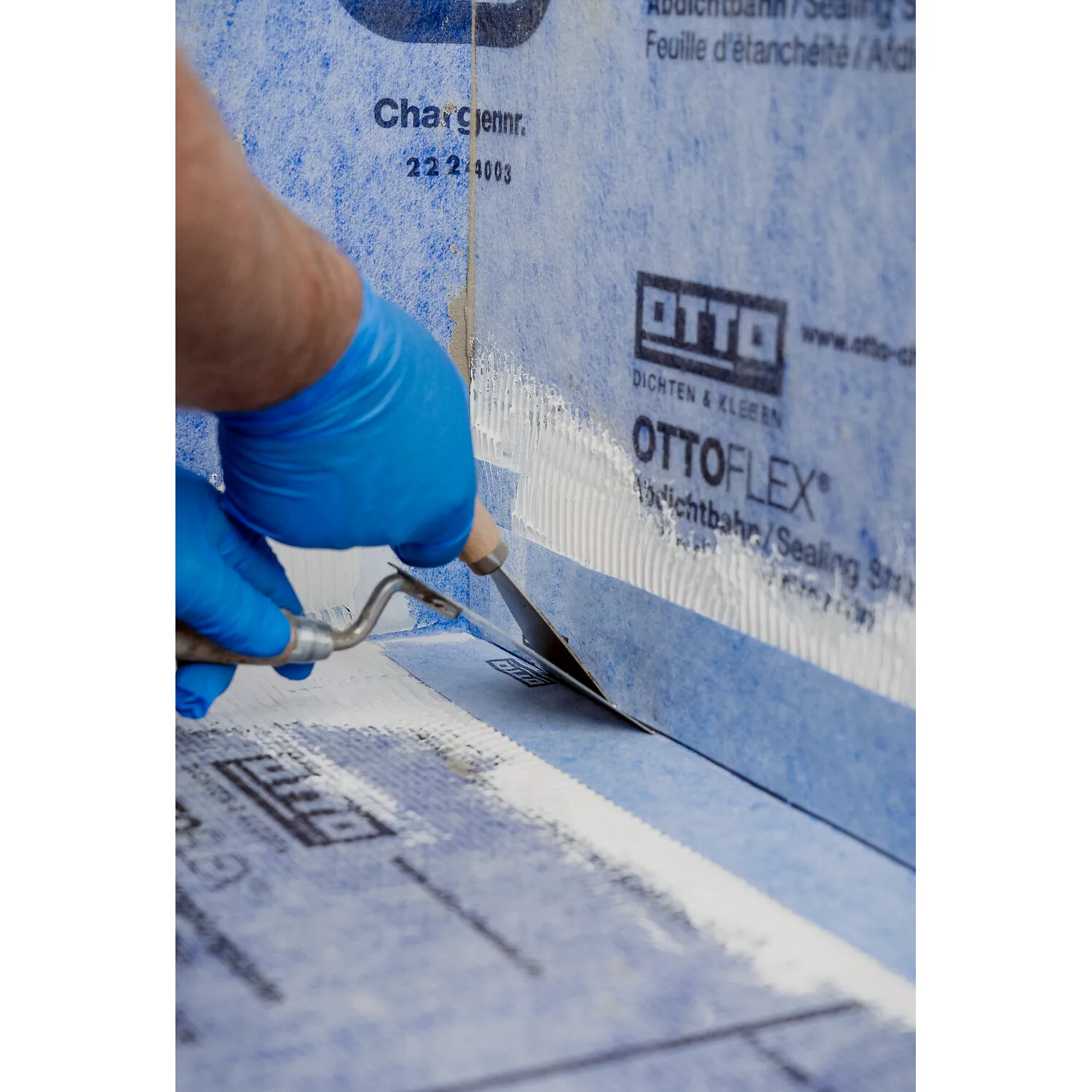
The short answer: sealing tape seals straight joints and edges – the wall-to-floor junction or the edge of a bath, for instance. Sealing collars seal round penetrations, that is pipes passing through a wall or floor. Both are embedded in fresh Ottoflex liquid membrane and together make up the bonded waterproofing to DIN 18534.
The quick decision: sealing tape or collar?

Ottoflex sealing tape For joints & edges
- For straight connection and movement joints: wall-to-floor junction, internal corners, balcony and terrace edges
- Width 120 mm, high transverse and longitudinal elasticity
- Tested to ETAG 022, 100 % impermeable to water
- Temperature-resistant from -20 °C to +90 °C

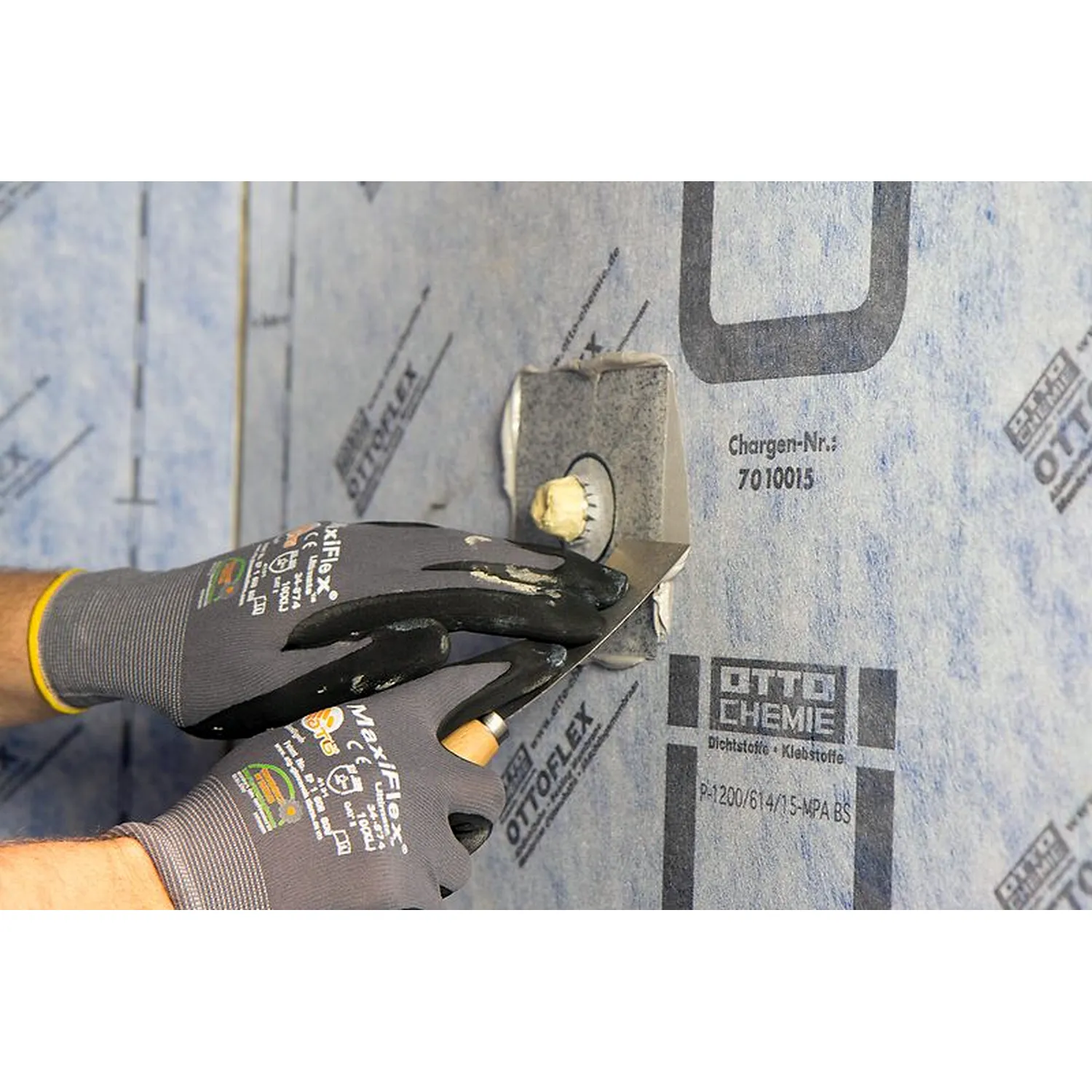
Ottoflex movement-zone collar For pipe penetrations
- For round pipe penetrations with an integrated movement zone, heating or water pipes for instance
- Three sizes for pipe diameters from 20 to 110 mm
- Tested to DIN 18534 and DIN 18535, EMICODE EC1 Plus
- Simple fitting: it is pulled over the builder's plug
Why sealing tape and collar are both needed
Under tiles in a shower, bathroom or on a balcony, silicone alone is not enough – the visible joint is only the last layer. The actual, lasting waterproofing is done by the bonded waterproofing underneath: a layer of Ottoflex liquid membrane in which sealing tape and collars are embedded. Straight junctions such as the wall-to-floor connection or the edge of a bath move differently from round pipe penetrations – which is why there are separate, exactly fitting components from the same system for both situations. You will find all components in the category sanitary waterproofing.
Which product for which situation?
| Situation | Matching product |
|---|---|
| Straight wall-to-floor junction, internal corners | Ottoflex sealing tape |
| Edge of a bath or shower tray | Ottoflex bath-edge sealing tape |
| Pipe penetration in the wall (the mixer tap connection, for instance) | Ottoflex wall sealing collar 15 x 15 cm |
| Floor drain or pipe penetration in the floor | Ottoflex floor sealing collar 42.5 x 42.5 cm |
| A single round pipe with a movement joint (Ø 20–110 mm) | Ottoflex movement-zone collar |
| Two pipes close together (a mixer tap with two connections, for instance) | Ottoflex double movement-zone collar |
The comparison in detail
| Criterion | Sealing tape | Sealing collar |
|---|---|---|
| Form | Flat tape from the roll | Pre-formed component, square with a round cut-out |
| Where it goes | Straight joints, edges, corners | Round pipe penetrations |
| Typical application | Wall-to-floor junction, bath edge, balcony/terrace | Wall and floor penetrations, heating and water pipes, mixer taps |
| Standards / tests | ETAG 022; bath-edge sealing tape additionally DIN 18534 | DIN 18534 (water exposure classes W0-I to W3-I), DIN 18535, ÖNORM B 3407, moisture exposure classes per ZDB and abP |
| Application | Lay into fresh liquid membrane, bond overlaps cleanly | Slip over the pipe penetration, press into fresh liquid membrane |
| Variants in the shop | Sealing tape (10 m / 50 m), bath-edge sealing tape (10 m / 25 m) | Wall, floor, movement-zone and double movement-zone collar |
Application: how tape and collar are bedded in
The substrate is first prepared with Ottoflex primer coat. A first layer of Ottoflex liquid membrane is then applied. The sealing tape, or the matching collar, is laid into the still fresh liquid membrane and pressed down over its full area – with the collar it is simply slipped over the pipe penetration. With the second coat, the whole area including the tape or collar is coated over.
The application temperature for all components is +5 °C to +35 °C. Because application and substrate affect adhesion, the manufacturer always recommends a trial application before the actual job.

Common questions about sealing tape and collars
What is sealing tape used for, and what is a collar used for?
Sealing tape seals straight joints and edges, such as the wall-to-floor junction or the edge of a bath. Sealing collars seal round pipe penetrations that pass through a wall or floor.
Which Ottoflex movement-zone collar fits my pipe?
It depends on the pipe diameter: 135 x 135 mm for 20–35 mm, 160 x 160 mm for 31–50 mm and 215 x 215 mm for 69–110 mm pipe diameter.
What do I use for two pipes close together, at a mixer tap for instance?
For two pipe penetrations close together, as occur with mixer taps, there is the Ottoflex double movement-zone collar with a double movement zone.
Which standard must the bonded waterproofing meet?
The Ottoflex components are designed for bonded waterproofing to DIN 18534. The movement-zone collar additionally meets water exposure classes W0-I to W3-I per DIN 18534 as well as requirements per DIN 18535 and ÖNORM B 3407.
How are sealing tape and collar applied?
Both are laid into the still fresh Ottoflex liquid membrane and pressed down. With the second coat the whole area is coated over. The application temperature is +5 °C to +35 °C.
Is silicone alone enough to waterproof the shower?
No. Silicone seals only the visible surface joint. The actual, lasting waterproofing is done by the bonded waterproofing of liquid membrane, sealing tape and collars underneath. More on that in the guide Which silicone for the shower? and in the guide Waterproofing a shower with liquid membrane and sealing tape.


