
Which foam gun? Comparison and buying advice
Contents
What you need
Project template “Apply PU foam”For occasional installation work a metal gun with fine adjustment such as the Basic foam gun is enough. Anyone who uses several cans a week is better off with a non-stick-coated professional gun such as the OTTO Dosier-Pistole PRO or the PTFE-coated Soudal professional foam gun: the foam does not stick inside, cleaning becomes considerably easier and the gun lasts longer. For deep wall openings there are models with a 60 cm long barrel. Important in every case: the gun fits only gun foam with a screw valve, not hand-held foam with a push-on straw.

The two recommendations compared directly

OTTO Dosier-Pistole PRO
- Completely non-stick-coated surface – prevents blockages
- Finely adjustable dosing needle with end-stop function
- Rubberised handle, can be held securely even with a glove
- Length 330 mm, height 200 mm, width 50 mm, weight approx. 0.33–0.46 kg
- Scope of delivery: 2 tubes (200 mm), 2 tips (Ø 4 mm, 48 mm), 2 fine nozzles (Ø 4 mm, 100 mm)
- For processing OTTOPUR OP 910, OP 915, OP 950 and OP 960
Who it is for: Fitters and tradesmen in constant use who want to spend little time on cleaning and need extensions for narrow joints.
Limitation: According to the manufacturer there is no spare-parts service for this gun.
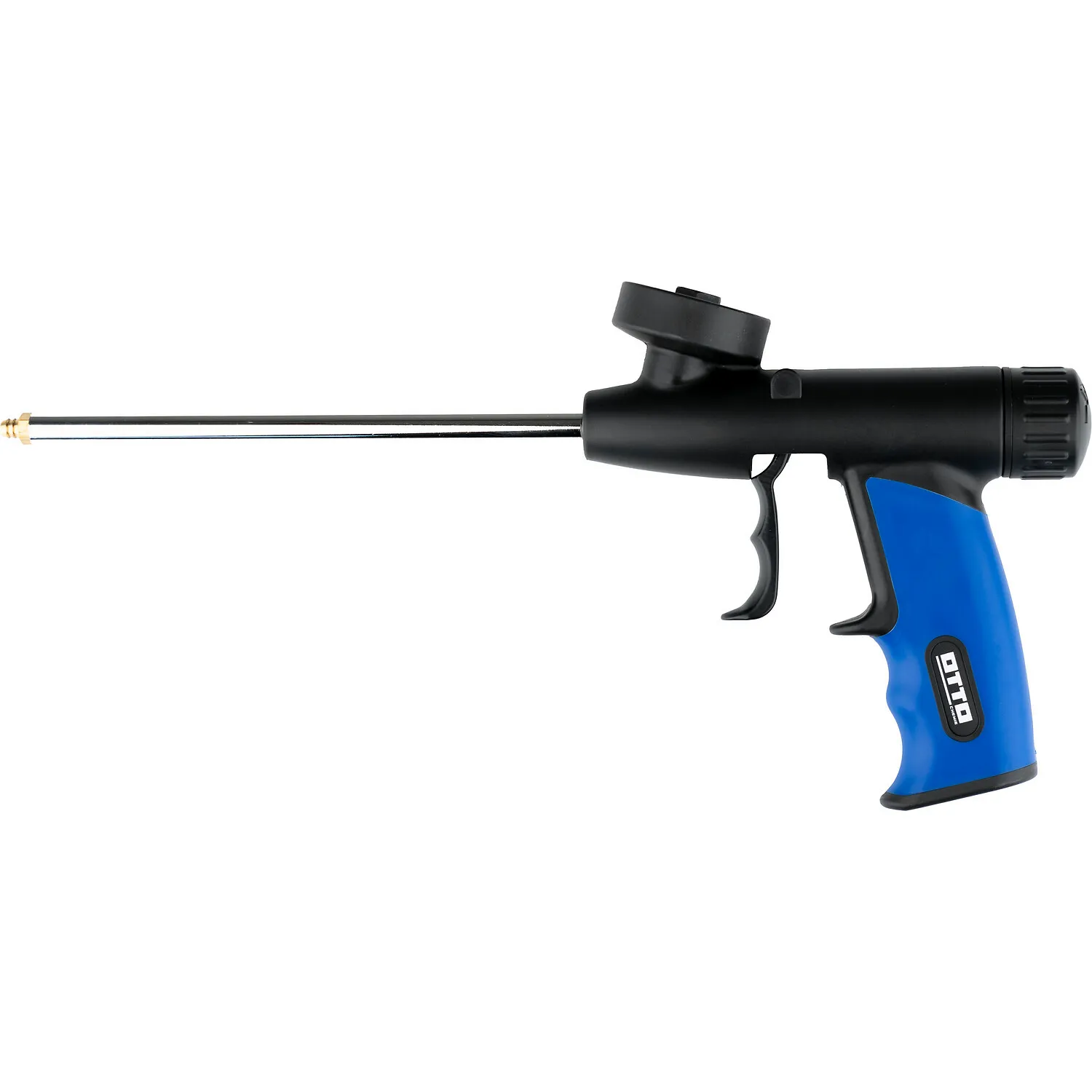
Basic foam gun
- Robust construction for long-lasting use
- Fine adjustment for precise foam output
- Ergonomic design for comfortable handling
- Compatible with all common PU foam cans
- Easy to clean and maintain
Who it is for: Window and door installation, joints and cavities with manageable consumption – the entry point for everyone who has so far worked with the push-on straw.
Limitation: without a non-stick coating. You have to clean more consistently, or leave the opened can screwed on.
Detailed comparison: all foam guns in the range
| Model | Body / coating | Dosing | Scope of delivery and special feature | Typical use |
|---|---|---|---|---|
| OTTO Dosier-Pistole PRO | Non-stick-coated metal, rubberised handle | Dosing needle with end stop | 2 tubes 200 mm, 2 tips Ø 4 mm, 2 fine nozzles Ø 4 mm/100 mm; reinforced can adapter | Daily professional use, narrow and deep joints |
| Soudal professional foam gun | Metal body with PTFE inner coating | Grippy dosing screw | 1 gun; offset gun barrel, robust can adapter | Constant use on the building site, window and door connections |
| Birtel Profi F4 | Metal, low dead weight | Knurled screw | 2 extension tubes of 20 cm each, 2 plastic tips; overall length 31 cm, supplied under pressure | Hard-to-reach cavities, frame installation |
| PF3 construction foam gun | Metal housing | Stepless fine adjustment screw on the handle | Can change without tools, fits commercially available PU foam cans | Fine joints and larger cavities alternately |
| Irion Metall Lite | Metal, chrome-plated brass tube, handle made of hard plastic | Metal adjusting screw plus trigger | Compact standard version; only for cans with a screw valve | Windows, doors, connection joints |
| Irion Metall Lite XL | Metal, 60 cm barrel made of non-stick alloy, triple seal set, rubberised handle | Brass adjusting screw | Extra long gun barrel | Deep wall openings, pipe penetrations |
| Basic foam gun | Robust construction, without non-stick coating | Fine adjustment | Compatible with all common PU foam cans | Occasional installation and renovation work |
| Professional foam gun with PU cleaner | Can be taken apart, standard screw thread | Adjusting screw | Set with 500 ml PU cleaner; long barrel | Initial equipment, if there is no cleaner in the house yet |
You will find an overview of all models with current prices in the category Foam guns.
Recommendation by application
One door, one window, then the gun goes back in the cupboard
The Basic foam gun or the set with 500 ml PU cleaner. With the set the cleaner is included straight away – exactly the item that occasional users most often lack and that then costs them the gun.
Several cans a week, building-site use
Non-stick or PTFE-coated: OTTO Dosier-Pistole PRO or Soudal professional foam gun. The coating prevents foam from setting inside and reduces the cleaning effort.
Deep wall openings and pipe penetrations
The Irion Metall Lite XL with a 60 cm long barrel made of non-stick alloy. With a compact gun you do not reach the bottom there – the manufacturer's information on the Lite names exactly this case as the limit.
Narrow joints and pinpoint dosing
Models with tubes and tips: OTTO PRO (fine nozzles Ø 4 mm) or Birtel Profi F4 (two 20 cm tubes plus tips). With them you reach joints that the gun head itself does not fit into.
Why a gun at all – and not the push-on straw?

With straw foam you press the foam directly out of the can – only your thumb regulates the quantity. With the gun the foam runs via trigger and adjusting screw: the flow is limited, the trigger doses with pinpoint accuracy, and according to the product information that is more economical and cleaner than with the tube.
The second point, more important for the cost: an opened can stays screwed onto the gun during breaks in work, without curing. So you do not have to dispose of a half-full can after one job. It is from this that the gun pays for itself – not from the nicer joint appearance.
Important limitation: Foam guns fit only 1K gun foam with a screw valve. Hand-held foam with a tube adapter cannot be applied with them. Which can you need is explained by our guide Gun foam or hand-held foam.
Cleaning: that is what kills most guns
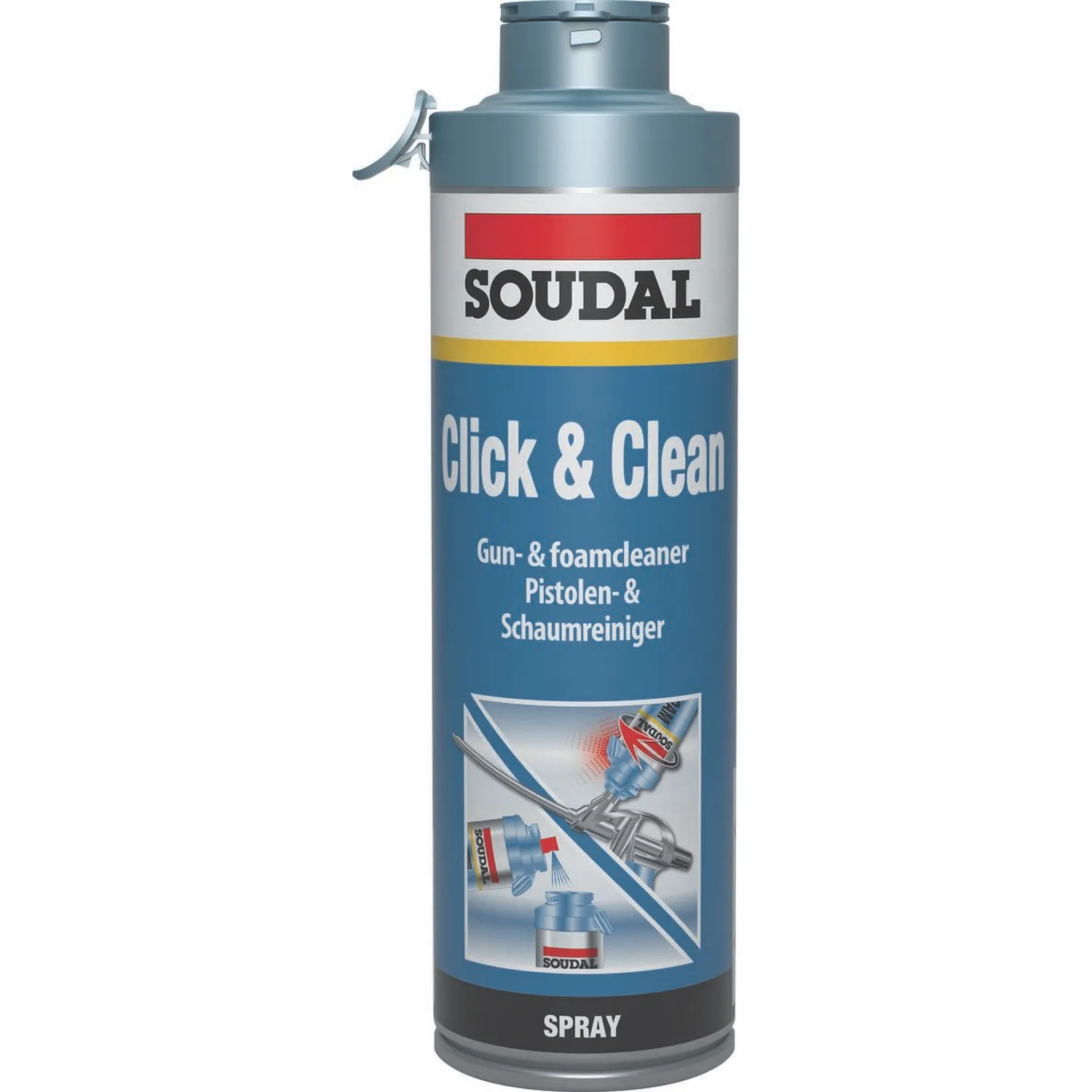
Cured PU foam can only be removed mechanically – inside a gun that as a rule means: the end. A gun and foam cleaner acts exclusively on fresh, not yet cured foam. It therefore belongs with the gun like the can itself.
- During breaks in work: close the adjusting screw, leave the can screwed on. The system stays closed, as a rule nothing cures in the barrel.
- When changing cans: screw on the new can promptly so that no foam cures in the barrel.
- Internal cleaning: screw the cleaner can onto the gun and operate the trigger several times at intervals of 10–15 seconds.
- External cleaning: with the red adapter supplied with the cleaner can.
- Check compatibility: plastics as well as paint and varnish coatings can be attacked by the cleaner.
Two manufacturer tips from the product data that extend the service life: with the Soudal professional foam gun, oil the dosing screw lightly before first use; with the OTTO PRO, close the adjusting screw after use and always leave a partly filled can mounted.
Common mistakes when buying – and how to avoid them
- Gun bought, straw foam on the shelf: The can must have a screw valve. Gun foam and hand-held foam are not interchangeable.
- Compact gun for the wall opening: For deep openings the extended barrel is needed, otherwise the cavity stays empty at the back.
- Forgot the cleaner: Without cleaner the first cured filling is often also the last.
- Joint foamed full: The foam keeps expanding. Fill joints only partly – the can specifies the degree of filling. You can estimate the quantities for your project with the construction foam calculator.
- Can held wrongly: Shake the can vigorously, screw it on with the valve facing up, and hold the gun with the can facing up.
How the foam then gets cleanly into the joint is explained in the instructions Applying PU foam correctly. Which foam suits windows and doors is explained by Which PU foam for window installation. And if something does go wrong: Removing PU foam.
Frequently asked questions
Does every foam gun fit every construction foam can?
No. Foam guns fit 1K gun foam with a screw valve. Hand-held foam with a tube adapter is not intended for guns. Within gun foam cans the threads are standard; the guns in the range are compatible with all common PU foam cans.
Do I have to clean the gun after every use?
No. As long as the can stays screwed on, the system is closed and the foam as a rule does not cure in the barrel. Cleaning is done when the can is taken off or before longer storage – with gun cleaner, as long as the foam is still fresh.
What does the non-stick or PTFE coating achieve?
The coating prevents PU foam from adhering inside and gluing up the barrel. That reduces the cleaning effort and extends the service life – the reason why coated guns are recommended for constant use.
When do I need a gun with a 60 cm barrel?
With deep wall openings and pipe penetrations where you cannot reach the bottom of the cavity with a compact gun. For windows, doors and normal connection joints the standard length is the better choice, because it is handier.
What are tubes, tips and fine nozzles for?
They extend and narrow the outlet so that you can reach narrow or hard-to-reach joints. The OTTO PRO is supplied with two tubes (200 mm), two tips (Ø 4 mm) and two fine nozzles (Ø 4 mm, 100 mm), the Birtel Profi F4 with two 20 cm tubes and two plastic tips.
Can I still remove cured foam from the gun?
Not chemically. Cleaners act only on fresh foam; cured foam can be removed exclusively mechanically. Models that can be taken apart, such as the gun from the 2-piece set, can be opened completely for this; with closed guns usually only replacement remains.
Questions about the choice? Baustoffheld, Lindenstrasse 56, 47623 Kevelaer, telephone +49 (0) 2831 - 916 77 03.
Matching calculator
More guides on this topic
All guides on “PU foam, windows and roofs” Problem solving
Guide: PU foam will not cure – causes and fix
Why PU foam stays tacky or collapses and how to repair the connection
 Comparison
Guide: gun foam or hand-held foam – which is better?
Gun foam or hand-held foam: when the foam gun is worthwhile and when not
 Problem solving
Guide: removing PU foam – fresh and cured
Remove fresh PU foam with cleaner, cured foam mechanically and with remover gel