
Which wood glue – D3 or D4?

Contents
What you need
Project template “Glue wood”The short answer: For furniture, interior fit-out and anything that gets damp at most occasionally, a D3 white glue on a PVAc basis is enough – it is cheaper, cleaner to work with and dries transparent. As soon as components are permanently exposed to weather or constant moisture – windows, front doors, rafters, structural timber – you need a D4 PU glue. It also bonds on damp wood and, by foaming up slightly, bridges gaps as well. The difference in price is small, the difference in moisture resistance is not.
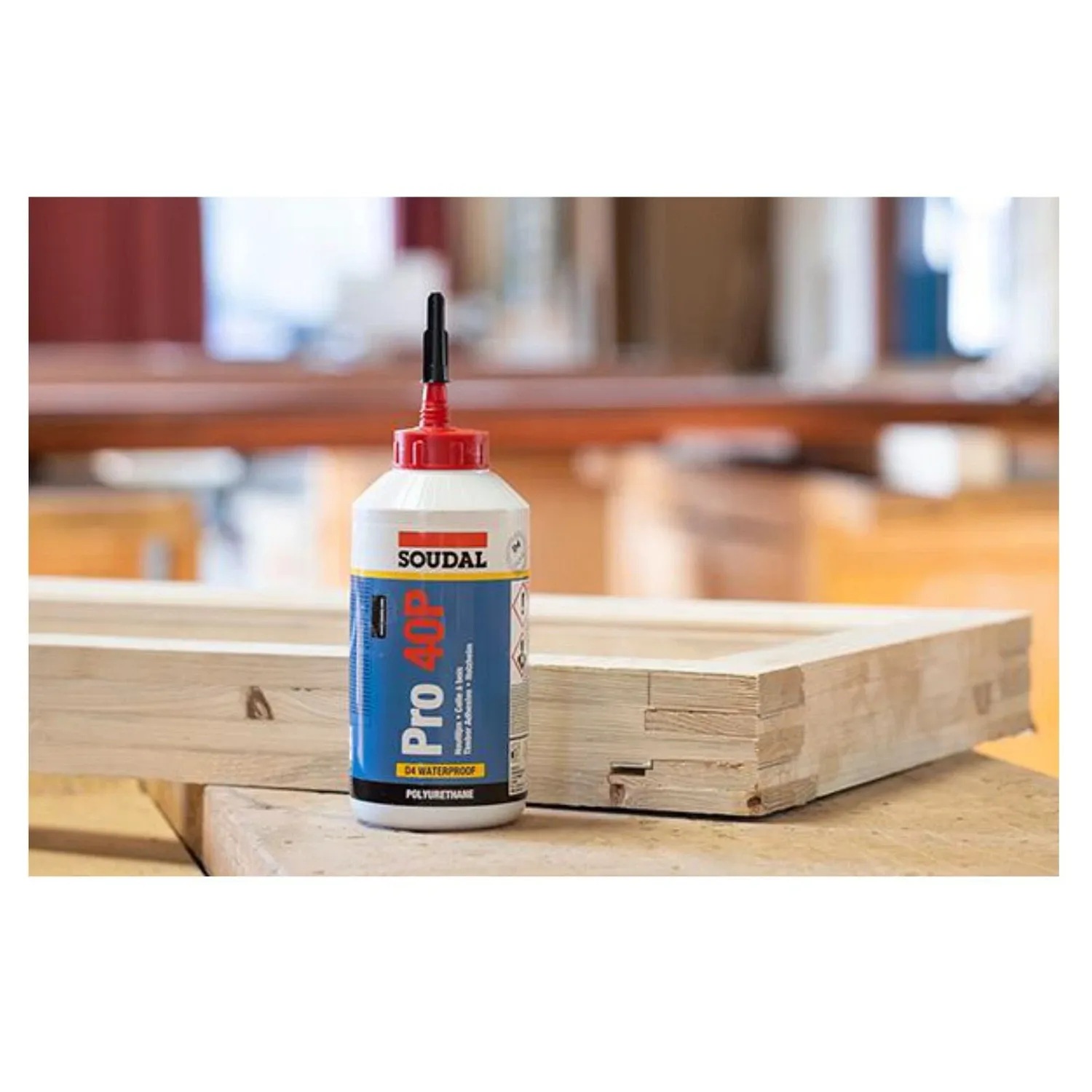
What D3 and D4 actually mean
D3 and D4 are durability classes to DIN EN 204. They do not describe the bond strength when dry but the water resistance of the glue line. Both classes hold without problems in a dry interior – they differ only once water comes into play.
- D3 – Interior with frequent short-term exposure to running or condensing water and to high humidity. Outdoors only with weather protection, that is under paint, stain or a roof.
- D4 – Interior with frequent, longer-lasting exposure to water, and exterior with weathering. This is the class that is required in window and door construction.
Important: the class says nothing about the chemical basis. In practice D3 glues are mostly water-based PVAc white glues, D4 glues mostly moisture-curing polyurethane (PU) glues. It is precisely from this that the differences in application arise.
Both candidates compared directly

Soudal Pro 30D – D3 white glue (PVAc)
- Waterproof to DIN EN 204 D3
- Open time approx. 8 minutes, pressing time 10–15 min. for board joints
- Dries transparent, no staining
- Solvent-free, low odour, washable with water while fresh
- Ideal for solid wood, chipboard, veneer, HPL/CPL on MDF
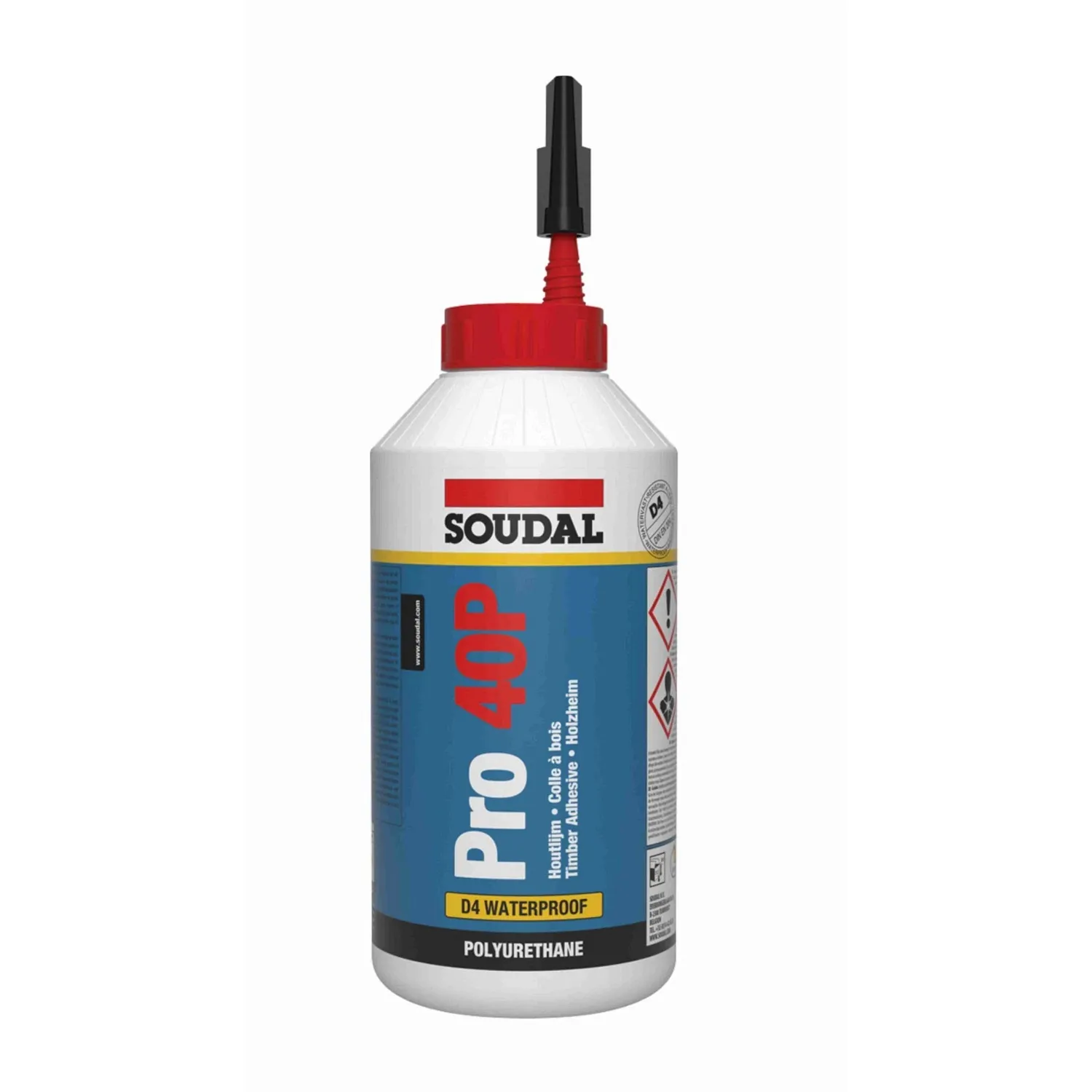
Soudal Pro 40P – D4 PU glue
- Waterproof to DIN EN 204 D4 (test report 50531721/1e, ift Rosenheim)
- Open time approx. 15 minutes, pressing time at least 3 hours
- Bonds on damp wood too, foams up slightly and thereby bridges gaps
- Also on concrete, stone and many plastics – not on PE, PP, PTFE, polystyrene foam, silicone, bitumen
- Colour brown, application +5 °C to +35 °C
Detailed comparison
| Feature | Pro 30D (D3, PVAc) | Pro 40P (D4, PU) |
|---|---|---|
| Durability class DIN EN 204 | D3 | D4 |
| Basis | PVAc dispersion, water-based, solvent-free | Polyurethane, moisture-curing |
| Colour | white, dries transparent | brown |
| Open time | approx. 8 minutes | approx. 15 minutes |
| Pressing time | 10–15 min. (board joint), 8–15 min. (assembly) | at least 3 hours |
| Damp wood | no – optimum wood moisture 8–10 % | yes, moisture even accelerates curing |
| Gap bridging | no, a tight fit is needed | yes, by foaming up slightly |
| Application temperature | optimum 18–20 °C, 60–70 % rel. humidity | +5 °C to +35 °C |
| Viscosity / density | 8,000–15,000 mPa·s, approx. 1.10 g/ml | unfilled, approx. 1.1 g/ml |
| Cleaning while fresh | with water | gun / foam cleaner or acetone |
| Cleaning once cured | mechanically only | mechanically only |
| Shelf life | approx. 10 months, cool and dry | approx. 12 months, unopened, cool and dry |
| Pack sizes in the shop | 750 g bottle, 5 kg | 750 ml bottle, 5 kg |
Recommendation by application
Furniture, shelves, interior fit-out
Dry interior, clean fit, visible joints: D3 white glue. The short pressing time of around 15 minutes allows several glue-ups a day, and the glue line that dries transparent does not stand out on light wood.
Kitchen and bathroom
Splashes and high humidity, but no weathering: D3 is enough. That is exactly what the class is made for – simple D2 white glues from the DIY store are too weak here.
Windows, front doors, rafters
Permanent weather exposure and a load-bearing function: D4 PU glue, no discussion. For windows and exterior doors D4 is the standard that testing institutes also take as their basis.
Freshly delivered, damp wood
If the wood moisture is well above 10 %, white glue fails – it needs to release water into the wood in order to set. Here you reach for the PU glue, which actually needs moisture to cure.
Visible joint on light wood, but D4 required
Brown PU glue would stand out: take the transparent Purocol Express (D4, transparent) with 5 minutes of open time and 60 minutes of pressing time.
Cycle time in the workshop is tight
The Pro 45P is the fast-curing D4 version: only 5 minutes of open time, but cured after just 30 minutes of pressing at 1–2 kg/cm², shear strength from 10 N/mm².
Three mistakes that get really expensive in practice
- Taking D4 as a universal solution. PU glue foams up. On neatly jointed furniture parts it squeezes out of the joint and has to be chiselled off mechanically – on stained or oiled wood that leaves visible spots. Where D3 is enough, D3 is also the better result.
- Falling short of the pressing time. Three hours of clamping pressure with the Pro 40P are not a guide value but the condition for the stated strength. Anyone who releases after 30 minutes gets a joint that only opens up after months.
- Gluing at too low a temperature. Below +5 °C the PU glue does not cure properly; the white glue wants 18–20 °C. In the unheated workshop in winter this is the most frequent reason for joints that do not hold.
If something has gone wrong after all: our instructions for loosening wood glue explain how to get a glued joint apart again without destroying the component.
And what if wood is to go onto another material?
Wood glue – whether D3 or D4 – is intended for wood-to-wood and cures rigid. As soon as you join wood to metal, glass, tiles or plastic, the materials move to different degrees and the rigid joint cracks. For that you take an elastic adhesive and sealant: see our guide on MS polymer as an adhesive and sealant. Where silicone is suitable as an adhesive and where it is not is explained in the guide Bonding with silicone.
You will find all the glues from this comparison in the category Wood glues & parquet adhesives. For simple repairs in a dry interior the classic Ponal Classic white glue is also enough.
Frequently asked questions
Is D4 always better than D3?
No. D4 is more waterproof, but not automatically the better choice. PU glues are brown, foam up and, at three hours minimum, need pressure for considerably longer. In dry furniture making a D3 white glue is cleaner, faster and cheaper.
Is D3 enough in the bathroom?
Yes, as long as the component is not permanently standing in water. D3 is defined for frequent short-term exposure to water and high humidity – that is, exactly for bathroom and kitchen. For components in the splash zone of a shower or outdoors take D4.
Can I use wood glue outdoors?
D4 yes, that is the class for weathering. D3 only if the joint stays permanently protected from water by paint, a roof or the construction.
How long do I have to press?
With the D3 white glue Pro 30D 10–15 minutes for board joints and 8–15 minutes for assembly bonds. With the D4 PU glue Pro 40P at least 3 hours, with the fast-curing Pro 45P at least 30 minutes at 1–2 kg/cm². The joint is only fully loadable after complete curing.
Why does PU glue get thicker as it cures?
It cures with air and wood moisture and foams up slightly as it does so. That is intended: in this way it fills small gaps in which a white glue would no longer have any contact. The squeeze-out is removed with a chisel after curing.
How do I get fresh glue off again?
Fresh D3 white glue with water, fresh PU glue with gun / foam cleaner or acetone. Once cured, only mechanical removal helps with either.
Not sure which class your component needs? Give us a call: Baustoffheld, Lindenstrasse 56, 47623 Kevelaer, telephone +49 (0) 2831 - 916 77 03.
More guides on this topic
All guides on “Bonding and assembly” Instructions
Guide: bonding a mirror – the guide that does not ruin the mirror
Bond a mirror with mirror adhesive and primer so that the coating stays intact
 Basics
Guide: bonding silicone – what holds and what does not
When silicone is enough as an adhesive, what it holds on and when a hybrid adhesive is better
 Basics
Guide: using PTFE spray and Teflon spray properly
What PTFE dry lubrication is good for, how to apply it and when oil is better